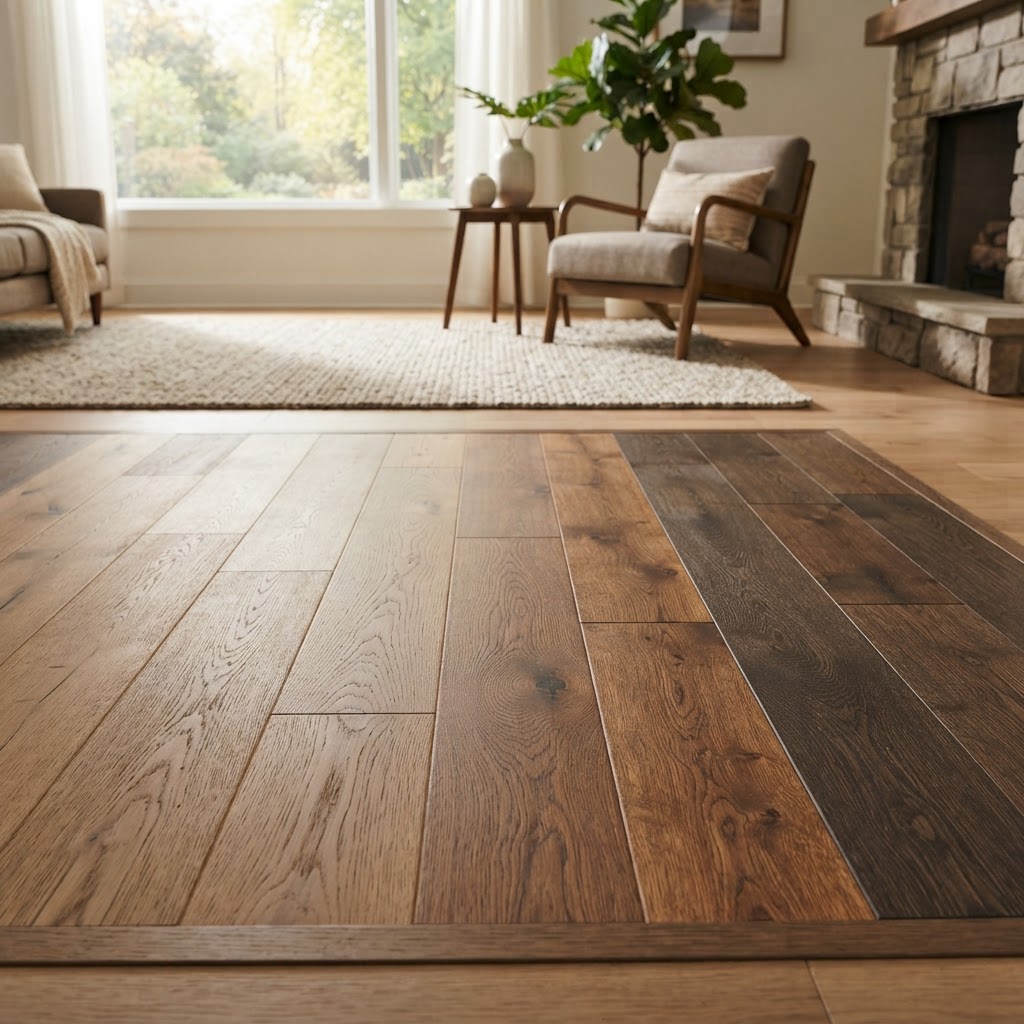
Why Maryland's Climate Makes Hardwood Flooring a Unique Challenge
Maryland sits in a climatic middle ground that most homeowners underestimate. We deal with hot, humid summers where relative humidity can climb above 70%, and cold, dry winters where interior humidity often drops below 30%. That swing — sometimes 40 percentage points or more over the course of a year — is the single biggest enemy of hardwood flooring. Wood is a hygroscopic material, meaning it constantly absorbs and releases moisture from the surrounding air. When it absorbs moisture, it expands. When it dries out, it contracts. Install the wrong species or the wrong product type in a Maryland home, and you will be calling a contractor within three years to address cupping, gapping, or squeaking.
As a general contractor who has worked on hundreds of homes across Baltimore City, Anne Arundel County, Howard County, and beyond, I want to give you the practical, honest guidance that helps you make a decision you won't regret.
Understanding Maryland Home Styles and Their Flooring Demands
The type of home you own matters as much as the climate outside. Maryland has an incredibly diverse housing stock, and each style presents different subfloor conditions and moisture challenges.
Baltimore Rowhomes
Baltimore's iconic rowhomes — many built between 1880 and 1940 — typically sit on brick foundations with crawl spaces or unfinished basements that were never designed with moisture control in mind. The subfloors are often original tongue-and-groove pine boards over floor joists, which means there is movement built into the system before you even install your new hardwood. In these homes, engineered hardwood is almost always the smarter choice over solid hardwood. The dimensional stability of a cross-ply engineered core tolerates subfloor movement and ambient humidity swings far better than a solid 3/4-inch plank.
Suburban Colonials and Craftsman Homes
In communities like Ellicott City, Lutherville, or Severna Park, you are more likely to find homes built on slab foundations or with conditioned basements. These homes often have more consistent interior humidity, especially if the homeowner runs a whole-home humidifier in winter. In these settings, solid hardwood becomes a more viable option — but species selection and acclimation time still matter enormously.
New Construction and Townhomes
Modern construction in places like Hanover or Odenton tends to use OSB subfloors and tighter building envelopes. These homes control humidity better, but they also tend to have radiant heat systems or high-efficiency HVAC that creates very dry conditions in winter. Wide-plank flooring, which is trendy right now, is especially vulnerable in these environments because wider boards have more surface area to expand and contract across the grain.
Best Hardwood Species for Maryland Homes
Not all wood species respond to humidity the same way. The Janka hardness rating tells you about scratch resistance, but what you really need to understand for Maryland is a species' tangential shrinkage coefficient — essentially, how much it moves as humidity changes. Here are the species I recommend most often to my clients:
- White Oak: This is my top recommendation for Maryland homes. White oak has excellent dimensional stability, a tight grain that resists moisture penetration, and it happens to be regionally appropriate — white oak trees are native to the Chesapeake watershed. It also accepts stain beautifully, which matters to homeowners who want a custom look. Janka hardness of 1360 means it holds up well in high-traffic areas.
- Hard Maple: Extremely dense and stable. Hard maple performs well in Maryland climates but can be difficult to stain evenly, so it is most popular in its natural or lightly finished state. A great choice for suburban colonials where a bright, clean aesthetic is desired.
- Hickory: One of the hardest domestic species available, hickory handles the humidity swings reasonably well and adds a dramatic, rustic character that suits older Maryland homes. The natural color variation in hickory also hides minor gapping during dry winters better than a uniform species like maple.
- Red Oak: The most common hardwood in American homes built before 2000. Red oak is more porous than white oak and slightly less stable, but it is widely available, cost-effective, and refinishable multiple times. If you are matching existing floors in an older Maryland home, red oak is often the only practical choice.
- Brazilian Cherry (Jatoba): I want to address this directly because it was extremely popular in the early 2000s. Jatoba is very hard, but it has a high shrinkage coefficient and it deepens significantly in color with UV exposure. In Maryland's mixed climate, I have seen Brazilian cherry floors develop chronic gapping issues. I do not recommend it for most Maryland installations.
Solid vs. Engineered Hardwood: The Real Maryland Answer
The debate between solid and engineered hardwood comes up in every single flooring consultation I do. Here is the straightforward answer for Maryland homeowners: if you have any doubt about subfloor moisture, basement proximity, or your ability to maintain consistent indoor humidity year-round, choose engineered hardwood.
Modern engineered hardwood is not the flimsy product it was 20 years ago. A quality engineered plank with a 4mm to 6mm wear layer of real hardwood can be refinished two or three times over its lifespan, giving you decades of service. Brands manufacturing to European standards have made engineered flooring that is genuinely difficult to distinguish from solid wood once installed.
For Baltimore rowhomes specifically, I almost always specify engineered white oak as the default. The combination of species stability and engineered construction addresses both the climate challenge and the subfloor variability you encounter in older urban homes.
Finish Selection Matters More Than Most Homeowners Realize
The finish on your hardwood floor is its first line of defense against Maryland's humidity. There are two main categories to understand:
- Surface finishes (polyurethane, aluminum oxide): These create a hard film on top of the wood that resists moisture penetration. Oil-modified polyurethane is durable and cost-effective. Water-based polyurethane dries faster and has lower VOCs. Pre-finished flooring with aluminum oxide finishes offers extreme durability but cannot be recoated easily.
- Penetrating oil finishes (Rubio Monocoat, Bona Craft Oil): These soak into the wood fiber and harden inside the grain. They create a natural, matte look that is very popular right now. The tradeoff is that they require more maintenance — spot treatments and periodic recoating — and offer slightly less moisture resistance in high-humidity conditions.
For Maryland homes, I generally steer clients toward a water-based polyurethane with a satin or matte sheen. It provides reliable moisture resistance, dries quickly so the home is back in service fast, and the reduced sheen hides the fine scratches and dust that show up so aggressively on glossy floors.
Acclimation: The Step Most Homeowners Skip
I cannot stress this enough. Hardwood flooring must acclimate to your home before installation. In Maryland, I require a minimum of five to seven days of acclimation, with the HVAC system running at normal living conditions. Flooring that is delivered from a climate-controlled warehouse in January and installed immediately into a house heated to 70°F will move. It will gap. It will call me three months later.
"The number one cause of hardwood floor failures I see in Maryland is improper acclimation combined with no humidity control plan. You can buy the best floor in the world and ruin it by rushing the install or ignoring your indoor humidity after move-in."
Practical Tips for Long-Term Hardwood Success in Maryland
- Install a whole-home humidifier. Maintaining indoor humidity between 40% and 55% year-round dramatically reduces seasonal movement in your floors. This is especially critical in Maryland winters when forced-air heating dries interior air significantly.
- Encapsulate your crawl space or condition your basement. If your home has a crawl space, ground moisture migrates upward and attacks your subfloor and flooring from below. A properly encapsulated crawl space is one of the best investments a Maryland homeowner can make before installing hardwood.
- Use a moisture meter before and during installation. Any reputable installer should be testing subfloor moisture content with a calibrated meter. Acceptable moisture content variance between the subfloor and the hardwood flooring material should be within 2-4% depending on the species and product.
- Avoid wide planks in problem areas. Planks wider than five inches look stunning, but they move more. If you love the wide-plank look, specify engineered construction with a stable core and keep your humidity controlled.
- Get a written warranty and understand what voids it. Most hardwood flooring manufacturer warranties are voided by moisture damage caused by failure to maintain proper indoor humidity. Read the fine print before you buy.
Final Thoughts from a Maryland Contractor
Hardwood flooring is one of the most rewarding investments you can make in a Maryland home. It adds genuine value, beauty, and warmth — and when it is specified and installed correctly for our climate, it lasts generations. The key is treating the decision with the seriousness it deserves: choose the right species, choose the right construction for your subfloor conditions, control your indoor humidity, and hire an installer who actually tests moisture before driving the first nail.
If you are planning a flooring project in the Baltimore metro area or Central Maryland and want guidance specific to your home's construction type and conditions, I am always happy to walk a property and give an honest assessment. The right floor for your neighbor's 1920s rowhome in Hampden may be completely different from the right floor for your 2005 colonial in Columbia — and getting that distinction right is what separates a floor you love for 40 years from one you are replacing in ten.