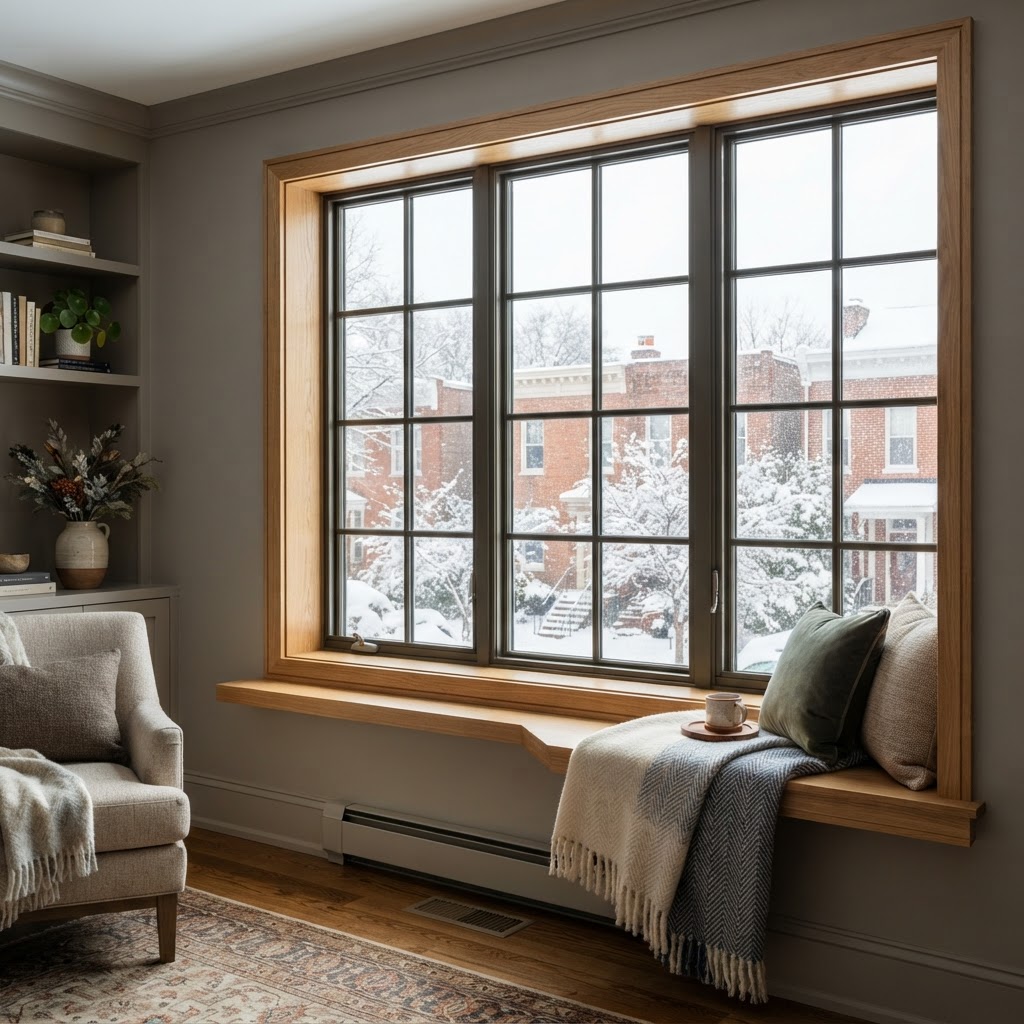
Why Baltimore Winters Demand More From Your Windows
Baltimore sits in a climate zone that most homeowners underestimate. We are not Minneapolis, but we are not Charlotte either. Between December and February, temperatures regularly drop into the low 20s overnight, and the Chesapeake Bay's proximity drives a damp, penetrating cold that makes a 28-degree Baltimore night feel worse than a dry 20-degree day in the Midwest. That moisture-laden air finds every gap, every failed seal, and every single-pane relic in your home and turns it into a heat loss highway.
As a licensed Maryland contractor (MHIC #105430) who has worked on everything from 1890s Federal Hill rowhomes to 1970s Colonial Revivals in Towson and Catonsville, I can tell you that window performance is one of the highest-leverage upgrades a Baltimore homeowner can make. Done right, it reduces heating bills, eliminates drafts, cuts down on condensation, and improves comfort in every room. Done wrong — or deferred indefinitely — it costs you money every single month.
This article will walk you through exactly what to look for, what to avoid, and how to make smart decisions specific to Baltimore's housing stock and climate.
Understanding Window Energy Performance Ratings
Before you talk to a single contractor or visit a single showroom, you need to understand two numbers: U-factor and Solar Heat Gain Coefficient (SHGC). These are the two ratings you will see on the NFRC label attached to every certified window.
U-Factor
U-factor measures how well a window prevents heat from escaping your home. The scale runs from 0.20 to 1.20, and lower is better. A single-pane aluminum window from the 1970s — still common in Baltimore's older rowhomes — might have a U-factor of 1.10 or higher. A quality double-pane window with a low-emissivity (low-e) coating runs between 0.25 and 0.30. For Baltimore winters, I recommend targeting a U-factor of 0.27 or below.
Solar Heat Gain Coefficient
SHGC measures how much solar radiation passes through the glass into your home. In a warm Southern climate, you want a very low SHGC to block heat. In Baltimore, the calculus is more nuanced. Our winters are cold enough that south-facing windows with a moderate SHGC (around 0.30 to 0.40) can actually help you collect passive solar heat during the day. North-facing windows, by contrast, receive almost no direct sun and should prioritize low U-factor over SHGC.
The Baltimore Rowhome Challenge
If you own a Baltimore rowhome — whether in Hampden, Canton, Charles Village, or Reservoir Hill — your window situation has unique constraints that a generic national contractor may not fully appreciate.
Most pre-war rowhomes were built with wood double-hung windows in narrow, tall openings. The rough opening sizes are often non-standard, which means replacement windows frequently need to be custom-ordered rather than pulled from stock. This adds cost and lead time, but it also means you should be deeply skeptical of any contractor offering an extremely fast turnaround on a rowhome window job.
Additionally, many Baltimore rowhomes are located in historic districts — Otterbein, Seton Hill, and parts of Fells Point and Federal Hill all have design review requirements. In these areas, you may be restricted from using certain frame materials or glass configurations that are visible from the street. Vinyl frames, for example, are prohibited in some historic districts. Aluminum-clad wood or fiberglass frames that mimic the original wood profile are typically approvable and also happen to perform excellently in cold weather.
Contractor Tip: Before you purchase a single window for a rowhome in a historic district, contact Baltimore City's Commission for Historical and Architectural Preservation (CHAP). A permit pulled without their review can result in a stop-work order and costly removal of already-installed windows.
Suburban Colonials and Split-Levels: Different Problems, Same Goal
Move out to the Baltimore suburbs — Towson, Pikesville, Ellicott City, Bel Air — and the housing stock shifts to postwar Colonials, Cape Cods, and split-levels. These homes were largely built between 1950 and 1985, and their original windows are either aluminum single-pane units or early double-pane windows whose insulated glass units (IGUs) have failed over time. Failed IGUs show up as permanent fogging or cloudiness between the glass panes — that seal failure eliminates most of the thermal benefit of double paning.
These homes typically have more standard opening sizes, which keeps replacement costs lower. They also tend to have more window area per square foot of wall than rowhomes, which means the return on investment from upgrading to high-performance windows is substantial. A 2,200-square-foot Colonial in Towson with 20 failed or single-pane windows can see heating cost reductions of 15 to 25 percent after a full window replacement with properly specified low-e double-pane units.
Frame Materials: What Actually Holds Up in Maryland
The frame material you choose affects both thermal performance and long-term durability. Here is an honest breakdown for Baltimore's climate:
- Vinyl (uPVC): The most common choice for suburban homes. Good thermal performance, low maintenance, and competitive pricing. Quality matters enormously — multi-chamber vinyl frames from manufacturers like Simonton, Alside, or Andersen's Renewal line outperform cheap single-chamber frames significantly. Vinyl expands and contracts with temperature swings, so proper installation with adequate clearance is critical.
- Fiberglass: The best overall performer for Baltimore's climate. Fiberglass expands and contracts at nearly the same rate as glass, which means fewer seal failures over time. It is stronger than vinyl, paintable, and dimensionally stable. The trade-off is cost — fiberglass windows typically run 20 to 30 percent more than comparable vinyl units. Brands like Marvin Integrity and Pella Impervia are worth the premium for whole-house replacements.
- Aluminum-clad Wood: Excellent for historic rowhomes and high-end suburban homes. The wood interior provides warmth and paintability; the aluminum exterior handles weather without rotting. More expensive and requires professional installation. Andersen 400 Series and Marvin Clad are the standard references.
- Bare Aluminum: Avoid for thermal performance. Aluminum is highly conductive, meaning it transfers cold directly into your home and is prone to condensation along the frame. Unless you are doing a commercial storefront application, there is no good reason to install aluminum frames in a Baltimore residence.
Low-E Glass Coatings: The Single Most Important Upgrade
If there is one specification that moves the needle more than any other, it is low-emissivity (low-e) glass coating. Low-e coatings are microscopically thin metallic layers applied to one or more surfaces of the glass. They reflect long-wave infrared radiation — the heat radiating from your warm interior walls and furniture — back into the room rather than allowing it to escape through the glass.
For Baltimore's mixed climate, a double-pane window with a low-e coating and argon gas fill between the panes is the appropriate baseline specification. Argon is a denser gas than air, which slows convective heat transfer between the panes. This combination typically achieves U-factors in the 0.25 to 0.30 range — a dramatic improvement over uncoated double pane (U-factor around 0.48) and a radical improvement over single pane (U-factor around 1.10).
Triple-pane windows are available and do perform better in extreme cold climates, but for most Baltimore applications, the marginal gain over a properly specified double-pane unit does not justify the added cost and weight. Triple pane makes more sense for exposed locations — north-facing walls, homes on elevated lots with wind exposure, or addition projects where thermal bridging through a new wall assembly is already a concern.
Installation Quality: Where Good Windows Go Wrong
The best window in the world performs poorly if it is installed carelessly. In Maryland's wet winters, improper flashing around the window frame is the number one cause of water intrusion damage. Every replacement window installation should include:
- Proper flashing tape at the sill and jambs before the window is set — not applied as an afterthought over the exterior casing.
- Continuous bead of sealant between the window frame and the rough opening on the interior side, with a low-expansion foam backing rod for larger gaps.
- Sloped sill pans where structurally feasible, to direct any incidental water outward rather than into the wall cavity.
- Proper shimming to ensure the window is plumb, level, and square — a racked frame will cause operating problems and seal failures within a few years.
Always ask your contractor to walk you through their flashing and air-sealing process before work begins. If they look puzzled by the question, find a different contractor.
Maryland and Federal Incentives Worth Knowing
As of the current tax year, the federal Energy Efficient Home Improvement Credit (25C) allows homeowners to claim 30 percent of the cost of qualifying exterior windows, up to a $600 annual cap. Windows must meet ENERGY STAR's Most Efficient criteria to qualify, which for the North-Central climate zone (where Baltimore falls) means a U-factor of 0.22 or below and an SHGC of 0.22 or below.
Maryland's Residential Clean Energy Rebate Program and BGE's Smart Energy Savers Program periodically offer rebates on qualifying window projects. These programs change annually, so verify current availability through the Maryland Energy Administration (energy.maryland.gov) before finalizing your project scope.
Making the Right Decision for Your Home
Energy-efficient windows are not a luxury upgrade in Baltimore — they are a practical investment in a climate that tests your building envelope every winter. Whether you own a century-old rowhome in Hampden or a 1980s Colonial in Hunt Valley, the core principles are the same: target a U-factor at or below 0.27, specify low-e coatings with argon fill, choose a frame material appropriate to your home style and neighborhood requirements, and insist on professional installation with proper flashing and air sealing.
Get at least three written quotes. Ask each contractor to specify the exact window model, NFRC ratings, and installation method in writing. Compare those documents — not just the bottom-line prices. The cheapest quote is frequently the most expensive outcome.
If you have specific questions about window replacement for your Baltimore-area home, feel free to reach out. This is exactly the kind of project where the right guidance upfront saves significant money and frustration down the road.