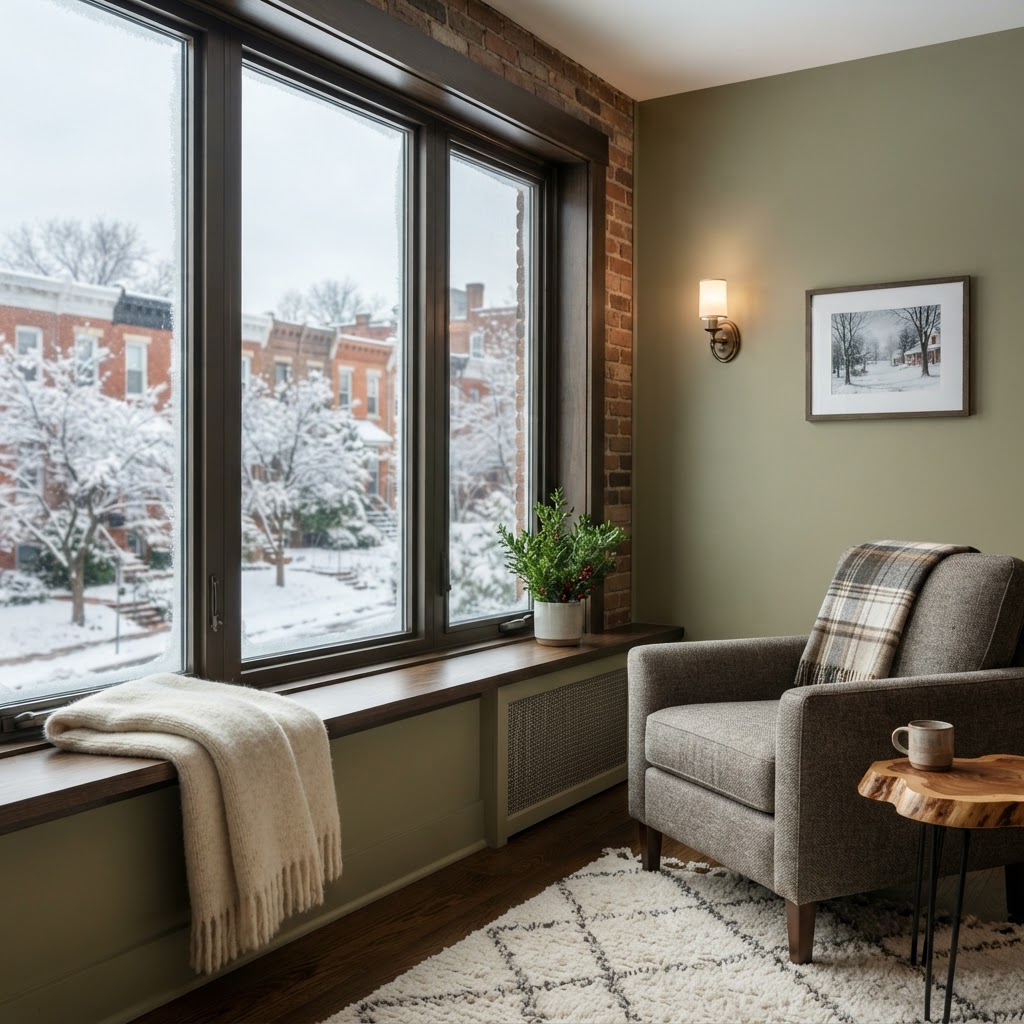
Why Baltimore Winters Demand Better Windows
Baltimore sits in a climate zone that many homeowners underestimate. We're not Minneapolis, but we're not Atlanta either. The Chesapeake region delivers a punishing mix of damp cold, icy winds off the Bay, and temperature swings that can drop 30 degrees in a single afternoon. Average winter lows hover in the mid-20s°F, and the humidity that makes our summers miserable turns around and drives bone-deep cold straight through poorly insulated window frames come January and February.
As a contractor who has worked on everything from century-old Patterson Park rowhomes to newer suburban colonials in Towson and Ellicott City, I can tell you this without hesitation: your windows are almost certainly your home's biggest source of winter heat loss. Not your attic. Not your crawlspace. Your windows. And in a city where natural gas and electricity costs have climbed steadily over the past decade, that's money walking right out through your walls every single night.
This guide is written specifically for Maryland homeowners. I'm not going to recycle generic window-buying advice you could find anywhere. I'm going to tell you what actually matters here, in our climate, in our housing stock.
Understanding Window Performance Ratings
Before you talk to any window salesperson, you need to understand two numbers: U-Factor and Solar Heat Gain Coefficient (SHGC). These are the only objective measurements that matter when comparing windows.
U-Factor: Your Most Important Number for Baltimore Winters
U-Factor measures how much heat a window allows to escape. The lower the number, the better the insulation. For Baltimore's Climate Zone 4 (which covers most of Maryland), the ENERGY STAR program recommends a U-Factor of 0.27 or lower. Many builder-grade double-pane windows come in at 0.30 to 0.35 — that gap is significant over the course of a heating season.
Triple-pane windows can achieve U-Factors as low as 0.15 to 0.20. However, I want to be honest with you: for most Baltimore homes, the cost premium of triple-pane over a high-quality double-pane rarely pencils out financially. A well-specified double-pane window with low-e coating and argon gas fill hitting a U-Factor of 0.22 to 0.25 will serve you extremely well without the added weight and cost of a third pane.
SHGC: Balancing Winter Gain Against Summer Heat
Solar Heat Gain Coefficient measures how much solar radiation passes through the glass. For a mixed climate like ours, you want a moderate SHGC — typically between 0.25 and 0.40. Go too low and you're blocking free solar heat in January. Go too high and you'll be fighting solar gain all summer. South-facing windows in particular can benefit from a slightly higher SHGC to capture winter sun when it sits low in the sky.
Window Types That Work for Baltimore's Housing Stock
The architecture of your home plays a huge role in which window configurations make sense, both functionally and aesthetically.
Baltimore Rowhomes: Historic Charm, Modern Performance
If you own a Federal Hill, Hampden, or Waverly rowhome, you're dealing with windows that are often 80 to 120 years old. Many have original wood frames with single-pane glass, and some owners have already replaced those with cheap double-pane units that have since fogged or failed at the seals. The challenge here is twofold: performance and preservation.
For rowhomes in historic districts or with historic tax credits, you may need approval from the Commission for Historical and Architectural Preservation (CHAP) before replacing windows. Don't skip this step — the fines are real. In these cases, we often look at interior window inserts or storm window systems that dramatically improve thermal performance without altering the exterior appearance. Products like Indow inserts can drop your U-Factor significantly while keeping your historic trim and sash intact.
Where full replacement is permitted, double-hung windows are almost always the correct choice for rowhomes. They match the original proportions, allow proper ventilation in spring and fall, and are available from quality manufacturers in wood-clad or fiberglass frames that match historic profiles.
Suburban Colonials and Cape Cods: Performance First
In communities like Catonsville, Perry Hall, or Columbia, you have more flexibility. The predominant window styles are double-hung and casement, and homeowners here are typically more focused on energy savings and low maintenance than historic preservation.
For these homes, I consistently recommend fiberglass-frame windows over vinyl. Here's why: fiberglass expands and contracts at nearly the same rate as glass, which means the seals last longer and you're less likely to have air infiltration develop over time. Vinyl is cheaper upfront and performs adequately, but in my experience, quality fiberglass windows from manufacturers like Marvin, Pella, or Integrity will outlast vinyl by 10 to 15 years in our climate.
Casement windows deserve special mention for energy efficiency. Because they seal by pressing against the frame when closed (rather than sliding), they have virtually zero air infiltration when properly installed. If you have a wind-exposed side of your home — often the west or northwest face in Baltimore — replacing sliders or double-hungs with casements on that elevation can produce a noticeable difference in comfort and heating bills.
Low-E Coatings and Gas Fills: What You're Actually Paying For
Almost every energy-efficient window sold today comes with a low-emissivity (low-e) coating. This is a microscopically thin metallic layer on the glass that reflects radiant heat. For winter performance, you want a soft-coat low-e (also called sputtered low-e) on the interior-facing surface of the outer pane. This reflects heat back into your living space instead of allowing it to radiate outward through the glass.
Argon gas fill between panes is standard in most quality windows and provides meaningful improvement over air-filled units. Krypton gas offers better performance in a thinner space and is sometimes used in triple-pane units, but for standard double-pane applications, argon is entirely adequate and more cost-effective.
Pro Tip: When comparing quotes, always ask for the whole-window U-Factor, not the center-of-glass rating. Center-of-glass numbers look better but don't account for the frame and edge, which are often the weakest thermal points. The whole-window rating is what ENERGY STAR uses, and it's the honest comparison.
Installation: Where Good Windows Go Wrong
I've seen homeowners spend $800 on a premium window and then have it installed with gaps in the rough opening that eliminate half the thermal benefit. Installation quality matters as much as the product itself. In Maryland, window replacement requires a licensed contractor registered with the Maryland Home Improvement Commission (MHIC). Always verify your contractor's license at the Maryland DLLR website before signing anything.
Proper installation includes:
- Full removal of the existing window, not just a pocket installation where possible
- Inspection and repair of any water-damaged rough framing before the new unit goes in
- Continuous air sealing with low-expansion spray foam around the entire perimeter
- Proper flashing integration with your existing weather-resistant barrier
- Interior trim and finishing that closes any remaining gaps
Maryland and Federal Incentives Worth Knowing
The federal Energy Efficient Home Improvement Credit (25C), extended through the Inflation Reduction Act, allows you to claim 30% of the cost of qualifying windows, up to $600 per year. Windows must meet ENERGY STAR Most Efficient criteria to qualify. Keep your receipts and product certification documentation.
BGE and Pepco customers should also check current rebate programs through EmPOWER Maryland. Rebates change annually, but qualifying window projects have historically been eligible for additional utility incentives stacked on top of the federal credit.
What to Expect From Your Investment
A full window replacement on a typical Baltimore rowhome with 12 to 15 windows runs between $8,000 and $18,000 depending on window selection, frame conditions, and historic requirements. A suburban colonial with 20 to 25 windows might run $14,000 to $28,000 for quality products professionally installed.
After accounting for incentives and the reduction in heating and cooling costs, most homeowners in our climate see a payback period of 8 to 14 years on a high-quality installation. But comfort improvement is immediate. The first winter after a proper window replacement, you'll notice the difference in every room that faced the street.
Don't shop on price alone. In a market flooded with low-bid window contractors, the savings you think you're getting upfront often disappear within five years when seals fail, frames warp, or air infiltration creeps back in. Buy quality once, have it installed correctly, and you'll still be comfortable in that house when your grandchildren visit.