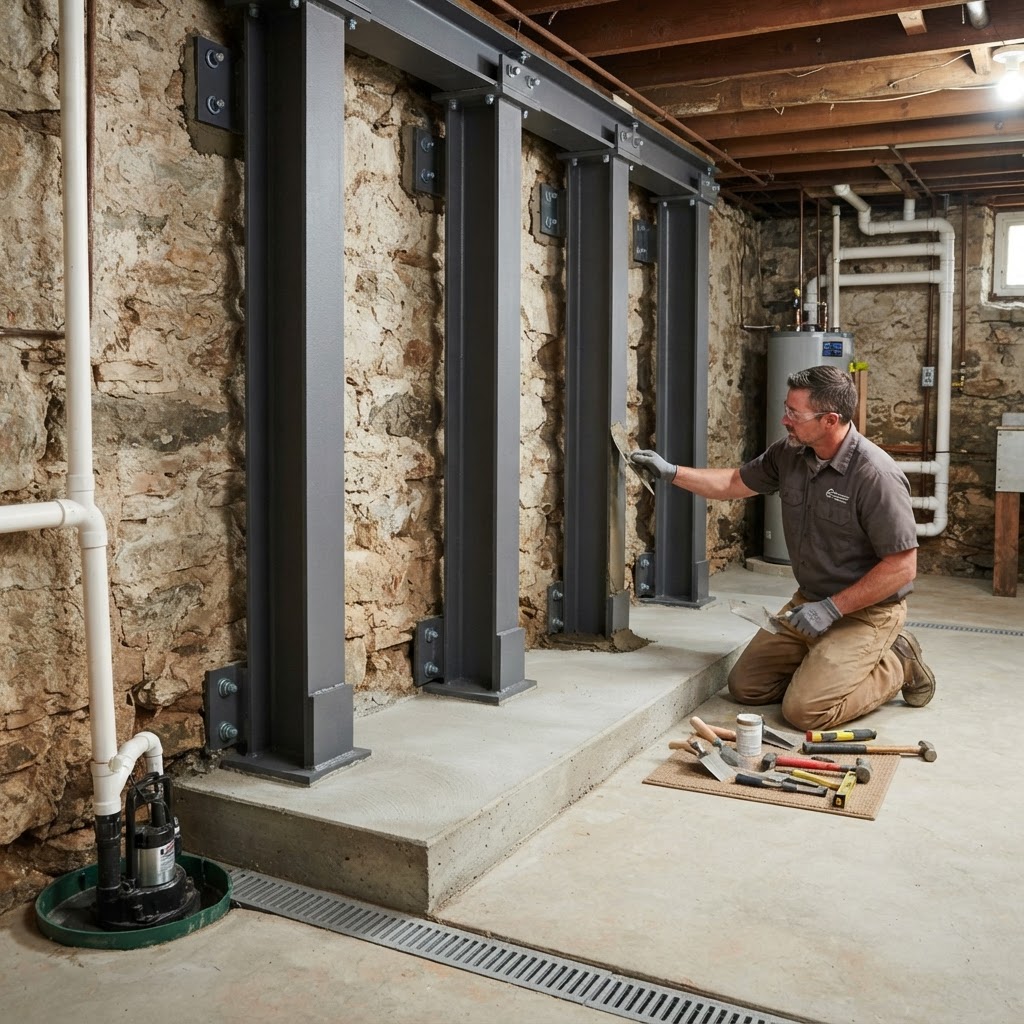
Why Maryland Homes Are Especially Vulnerable to Foundation Problems
Maryland sits at a geographic crossroads that creates a uniquely challenging environment for residential foundations. From the clay-heavy soils of the Piedmont Plateau to the shifting, moisture-laden ground of the Chesapeake Bay watershed, the Mid-Atlantic climate puts older homes through a relentless cycle of expansion and contraction. Add in the region's aging housing stock — much of it built before modern foundation engineering standards — and you have a recipe for serious structural concerns that homeowners need to understand before small problems become expensive disasters.
As a licensed Maryland Home Improvement Contractor, I've inspected and repaired foundations in Baltimore City rowhomes, 1950s Cape Cods in Anne Arundel County, brick colonials in Howard County, and stone-foundation farmhouses in Frederick and Carroll Counties. Each property type presents its own set of challenges, but the underlying causes are often the same: water, soil movement, and time.
Understanding Maryland's Soil and Climate Impact
The biggest enemy of any foundation is water — and Maryland delivers it in abundance. The state averages roughly 40 to 45 inches of rainfall annually, with significant moisture events concentrated in late spring and late summer. This constant wetting and drying cycle causes expansive clay soils to swell and shrink, placing lateral pressure on foundation walls and undermining the bearing capacity of footings.
In Baltimore and its older suburbs, a significant portion of homes were built on fill material, some of it poorly compacted, over what were once low-lying lots or stream corridors. When that fill settles unevenly, the foundation moves with it. In Western Maryland, frost heave is an additional concern — ground freezing to depths of 18 to 24 inches can push footings upward if they weren't poured below the frost line, which was sometimes ignored or miscalculated in homes built before the 1940s.
Common Foundation Types in Older Maryland Homes
Stone and Brick Rubble Foundations
Homes built before 1920 — particularly in Baltimore City, Annapolis, and rural counties — frequently have foundations constructed from fieldstone or brick set in lime mortar. Lime mortar is actually somewhat flexible and self-healing compared to modern Portland cement, but after 100-plus years, it deteriorates, washes out, and allows water infiltration. These foundations were never designed to be waterproof, and many homeowners are surprised to learn that chronic basement dampness in historic homes is essentially a design feature, not a defect — though that doesn't mean it should be ignored.
Poured Concrete and Concrete Block
Mid-century suburban homes from the 1940s through the 1970s typically feature either poured concrete walls or concrete masonry unit (CMU) block foundations. CMU block is particularly common in Baltimore's postwar suburbs and is notorious for horizontal cracking at the midpoint of the wall — a telltale sign of lateral soil pressure. Poured concrete walls crack vertically or diagonally as the structure settles, and these cracks become water entry points that accelerate deterioration if left unaddressed.
Baltimore Rowhome Party Walls and Shared Foundations
Rowhomes present a unique complication. In many Baltimore neighborhoods — Canton, Hampden, Remington, Federal Hill — homes share party walls and, in some cases, continuous foundation footings. A foundation repair on your home may be directly affected by conditions on your neighbor's property. I've seen situations where one homeowner invested in carbon fiber reinforcement on their basement wall, only to have the repair stressed because the adjacent vacant property had severe drainage issues pulling soil away from the shared wall. In rowhome situations, coordination with neighbors and sometimes the city is part of the repair process.
Warning Signs Every Maryland Homeowner Should Know
- Stair-step cracking in brick or block: This diagonal crack pattern following mortar joints is a classic indicator of differential settlement — the foundation is sinking unevenly.
- Horizontal cracks in block walls: This is a structural red flag. Horizontal cracking means the wall is bowing inward under soil pressure and requires prompt attention.
- Doors and windows that stick or won't close: When a foundation shifts, door frames rack out of square. This symptom is often dismissed as humidity-related swelling, but if it persists through dry weather, have the foundation evaluated.
- Gaps between walls and ceilings or floors: Separation at these joints indicates the structure is moving in ways it shouldn't.
- Water intrusion after heavy rain: Chronic seepage through walls or floor-wall joints suggests failing waterproofing or hydrostatic pressure building against the foundation.
- Efflorescence on basement walls: That white powdery residue is mineral salt left behind when water migrates through concrete or block. It's not structurally dangerous by itself, but it confirms water movement through your foundation.
Repair Options: Matching the Solution to the Problem
Carbon Fiber Straps and Wall Anchors
For bowing CMU or poured concrete walls with inward deflection less than two inches, carbon fiber reinforcement straps are often the most cost-effective solution. These high-tensile straps are bonded vertically to the interior face of the wall, stabilizing it against further movement. They don't require excavation, and they don't restore the wall to plumb — they halt progression. If the wall has moved more than two inches, wall anchors connected to stable soil in the yard can gradually pull the wall back toward its original position over one to two years with periodic tightening.
Piering and Underpinning
When a foundation has settled due to unstable or compressible soil, push piers or helical piers are driven or screwed down through the problem soil to bedrock or load-bearing strata below. The foundation is then lifted and stabilized on these piers. This is the appropriate solution for homes experiencing significant settlement — visible floor slopes, major diagonal cracking, or doors and windows badly out of alignment. In Maryland, helical piers are particularly common in areas with soft or fill soils near waterways.
Tuckpointing and Mortar Repair for Historic Foundations
For stone and brick foundations with deteriorated mortar, tuckpointing — removing failed mortar and repointing with an appropriate mix — is often the primary repair. This is more nuanced than it sounds. Using modern Portland cement mortar on a historic lime mortar foundation is a common and damaging mistake. Portland cement is harder and less permeable than the original masonry units, which means moisture that would normally evaporate through the joints instead migrates through the brick or stone, causing spalling and accelerated deterioration. Always use a mortar matched to the original composition.
Interior Drainage and Sump Systems
Where water intrusion is the primary problem rather than structural failure, an interior drainage system — a perimeter channel cut into the basement floor, connected to a sump pit and pump — manages hydrostatic pressure by giving water a controlled path of least resistance. This doesn't fix the source of the water, but it effectively protects the living space and reduces pressure against the walls. For most Maryland homeowners dealing with wet basements, this is part of a comprehensive solution.
What to Do Before You Call a Contractor
Document everything. Photograph cracks and measure their width with a quarter — anything wider than 1/4 inch warrants professional evaluation. Note whether cracks are active (growing) or stable by marking the ends with a pencil and the date. Check your gutters and downspouts: a significant percentage of Maryland basement water problems trace back to gutters that overflow or downspouts that discharge within four feet of the foundation. Grade the soil so it slopes away from the house at roughly one inch per foot for the first six feet.
"Before spending a dollar on basement waterproofing, make sure your gutters are clean and your downspouts are extended away from the foundation. I've seen $15,000 drainage systems installed in homes where a $200 gutter cleaning and downspout extension would have solved 80% of the problem."
Choosing a Qualified Foundation Contractor in Maryland
Foundation repair is not a project for unlicensed handymen or general laborers. In Maryland, any contractor performing home improvement work valued at $500 or more must hold a valid Maryland Home Improvement Commission (MHIC) license. You can verify any contractor's license status at the Maryland DLLR website. Ask specifically about their experience with your foundation type — a contractor who primarily does new construction waterproofing may not have the expertise to evaluate a 120-year-old stone foundation in Baltimore or a mid-century block wall in Catonsville.
Get at least three written estimates, and be skeptical of any contractor who diagnoses a severe structural problem on a five-minute walk-through or pressures you with same-day pricing. A legitimate foundation evaluation takes time, involves measuring wall deflection, assessing soil conditions, and reviewing the home's drainage patterns. The stakes are too high for shortcuts.
Maryland's older homes are among the most architecturally significant and personally meaningful properties in the region. With the right information and the right contractor, foundation problems that feel overwhelming are almost always solvable — and addressing them early keeps repair costs manageable and your home structurally sound for generations to come.