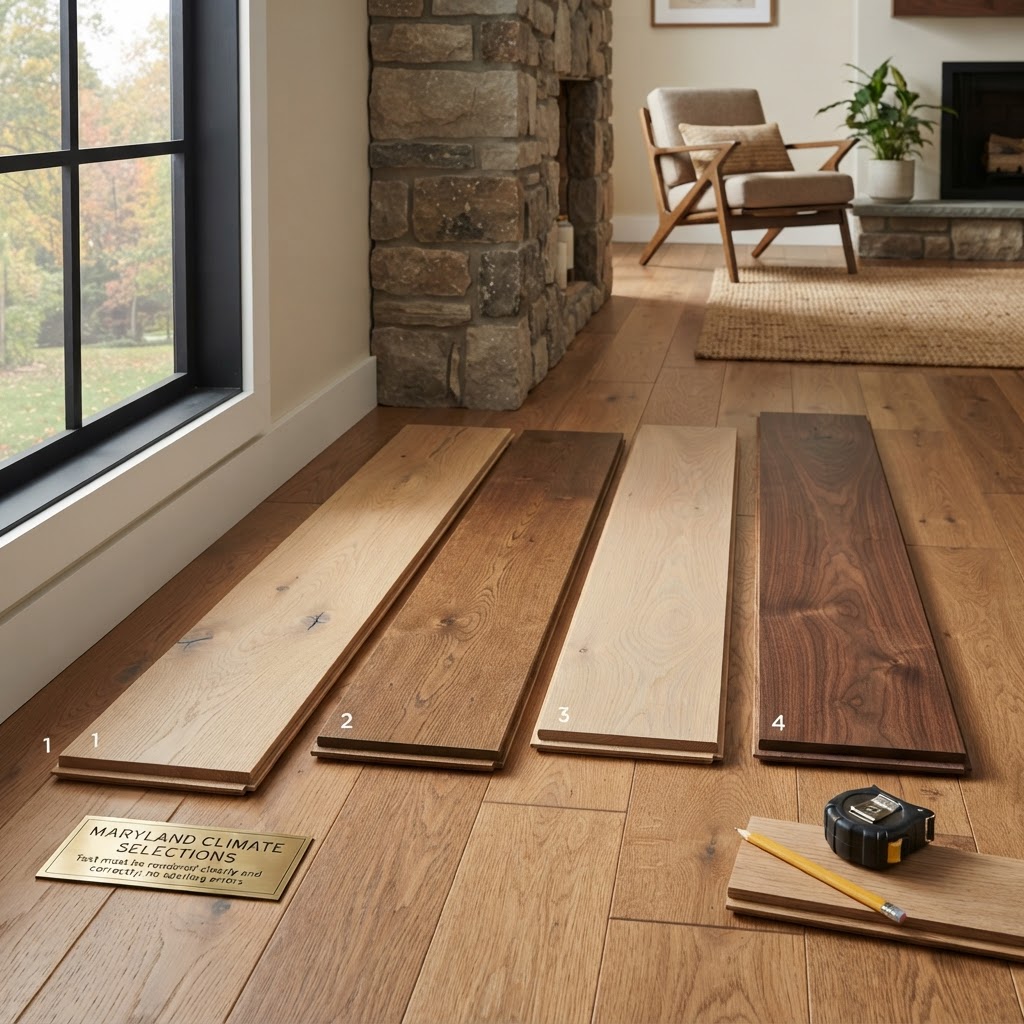
Why Maryland's Climate Makes Hardwood Flooring More Complicated Than You Think
Maryland sits in a uniquely challenging position on the climate map. We deal with hot, humid summers that regularly push relative humidity above 70%, cold and occasionally brutal winters, and shoulder seasons that swing dramatically within a single week. If you've ever watched a hardwood floor gap, cup, or buckle, you've seen firsthand what that kind of humidity swing does to wood. As a contractor who has installed and repaired flooring in everything from 100-year-old Baltimore rowhomes to brand-new suburban colonials in Howard County, I can tell you that species selection, installation method, and finish choice matter far more here than they would in, say, Arizona or the Pacific Northwest.
This guide is designed to help Maryland homeowners make smart, lasting decisions before the first plank goes down.
Understanding Maryland's Humidity Problem
The average indoor relative humidity in a Maryland home without climate control can range from roughly 30% in January to over 65% in July and August. Wood is hygroscopic, meaning it constantly absorbs and releases moisture from the surrounding air. When it absorbs moisture, it expands. When it releases moisture, it shrinks. Do that repeatedly over years, and you get cracked finishes, squeaky subfloors, and boards that no longer sit flush.
The first practical piece of advice I give every homeowner is this: invest in a whole-home humidification and dehumidification system before you install any hardwood floor. Keeping your indoor humidity between 35% and 55% year-round is the single most effective thing you can do to protect your investment. No species selection or installation technique fully compensates for a home that swings 40 points of relative humidity between seasons.
Hardwood Species That Perform Well in Maryland
Not all hardwoods behave the same way under humidity stress. The key measurement is the wood's tangential shrinkage coefficient — how much the wood moves across the grain as moisture changes. Lower movement means more dimensional stability. Here are the species I most commonly recommend to Maryland clients:
White Oak
White oak is my top recommendation for Maryland homes, full stop. It has a Janka hardness rating of 1,360 lbf, which means it holds up well to foot traffic, pets, and the general chaos of family life. More importantly, white oak has tyloses in its pores — a naturally occurring cellular structure that makes it less porous than red oak and more dimensionally stable in humid conditions. It also accepts stain beautifully, which matters when you're trying to match the warm tones of an older Baltimore rowhome or complement the neutral palette of a newer Ellicott City colonial.
Red Oak
Red oak remains the most commonly installed hardwood in Maryland for good reason — it's affordable, widely available, and familiar to most homeowners. It performs reasonably well in our climate, though it moves slightly more than white oak. If you go with red oak, I'd strongly advise acclimating the wood for at least 5 to 7 days in the actual room where it will be installed, not just somewhere in the house. Red oak is a fine choice; just manage your expectations and your humidity.
Hickory
Hickory is one of the hardest domestic species available, with a Janka rating around 1,820 lbf. It's an excellent choice for high-traffic areas and homes with large dogs. The trade-off is that hickory's pronounced grain and color variation can look busy in smaller rooms. I've installed hickory in mudrooms and open-plan kitchens in Anne Arundel County homes where it's held up beautifully for over a decade. It's not for everyone aesthetically, but it's nearly impossible to beat for durability.
Engineered Hardwood: The Practical Alternative
I want to be direct here: in many Maryland applications, engineered hardwood is the smarter choice, not a compromise. Engineered hardwood consists of a real hardwood veneer bonded to multiple layers of plywood or high-density fiberboard. That cross-ply construction dramatically reduces the wood's tendency to expand and contract. For basement installations, slab-on-grade homes, or any space where moisture is unpredictable, engineered hardwood outperforms solid hardwood in almost every measurable way.
Look for engineered products with a veneer layer at least 3mm thick. That allows at least one or two sandings over the life of the floor, which matters if you want to refinish rather than replace in 20 years.
Installation Considerations for Maryland Homes
Baltimore Rowhomes and Their Unique Challenges
If you own a rowhome in Baltimore City, Hampden, Fells Point, or any of the surrounding neighborhoods, you're likely dealing with original pine subfloors, uneven joists, and varying levels of moisture intrusion from shared walls. In these homes, I typically recommend floating or glue-down engineered hardwood rather than nail-down solid hardwood. The old subfloors often can't be adequately planed flat for a nail-down installation, and the shared wall construction creates moisture pathways that solid wood struggles to tolerate.
Many rowhome owners also want to preserve the character of the home. A white oak engineered floor in a wire-brushed or hand-scraped finish can look authentically period-appropriate while offering performance that original pine never could.
Suburban Colonials and Split-Levels
Homes in Columbia, Bowie, Rockville, and similar suburban communities typically have plywood subfloors over joists, which are ideal for nail-down or staple-down solid hardwood installation. These homes usually have central HVAC, which makes humidity management easier. In these settings, solid 3/4-inch white or red oak is entirely appropriate, provided the subfloor is level and dry.
For split-level homes with finished lower levels, pay close attention to the below-grade portions. Even a space that "feels dry" can have elevated moisture in the concrete slab. Always test with a calcium chloride test or a relative humidity in-slab probe before committing to any wood product on or below grade.
Finish Options and Maintenance Reality
Maryland homeowners are increasingly choosing oil-modified polyurethane or hard-wax oil finishes over traditional water-based polyurethane. Oil-modified finishes penetrate the wood rather than sitting on top of it, which means individual scratches and worn areas can often be spot-repaired without refinishing the entire floor. This is particularly practical in homes with children or pets.
Water-based polyurethane dries faster and has lower VOC content, which matters if you're refinishing in an occupied home. It also doesn't amber over time, which preserves lighter stain colors. The trade-off is a thinner build coat and less resistance to deep scratches. For most Maryland family homes, I recommend either a hard-wax oil system or a three-coat water-based poly with an aluminum oxide additive for extra durability.
Pro tip: Whatever finish you choose, add area rugs at exterior door transitions. Maryland's humidity and seasonal debris — pollen in spring, salt in winter — are tracked in constantly. Entry wear patterns are the number one reason Maryland homeowners call me for refinishing jobs within five years of installation.
What to Ask Your Contractor Before Signing Anything
Not every flooring contractor in Maryland is licensed through the Maryland Home Improvement Commission (MHIC). Before you hire anyone to install or refinish hardwood in your home, verify their MHIC license number at the Maryland DLLR website. A valid MHIC license means the contractor has passed a background check, carries appropriate insurance, and is accountable to a state regulatory body if something goes wrong.
- Ask whether they perform a moisture test on your subfloor before installation begins.
- Ask how long they acclimate the flooring and in what conditions.
- Ask what expansion gap they leave at the perimeter and at any thresholds.
- Ask for a written warranty that covers both materials and labor.
- Ask for references from projects in similar Maryland home types.
The Bottom Line for Maryland Homeowners
Hardwood flooring is one of the most valuable and most vulnerable investments you can make in a Maryland home. The right species, installation method, and finish — combined with proper humidity control — will give you a floor that outlasts your mortgage. The wrong combination will have you calling a contractor within five years wondering why your beautiful new floor looks like a roller coaster.
Maryland's climate demands respect. Work with a licensed professional who understands local conditions, asks the right questions before the job starts, and gives you a realistic picture of what to expect. Your floors will thank you for it.