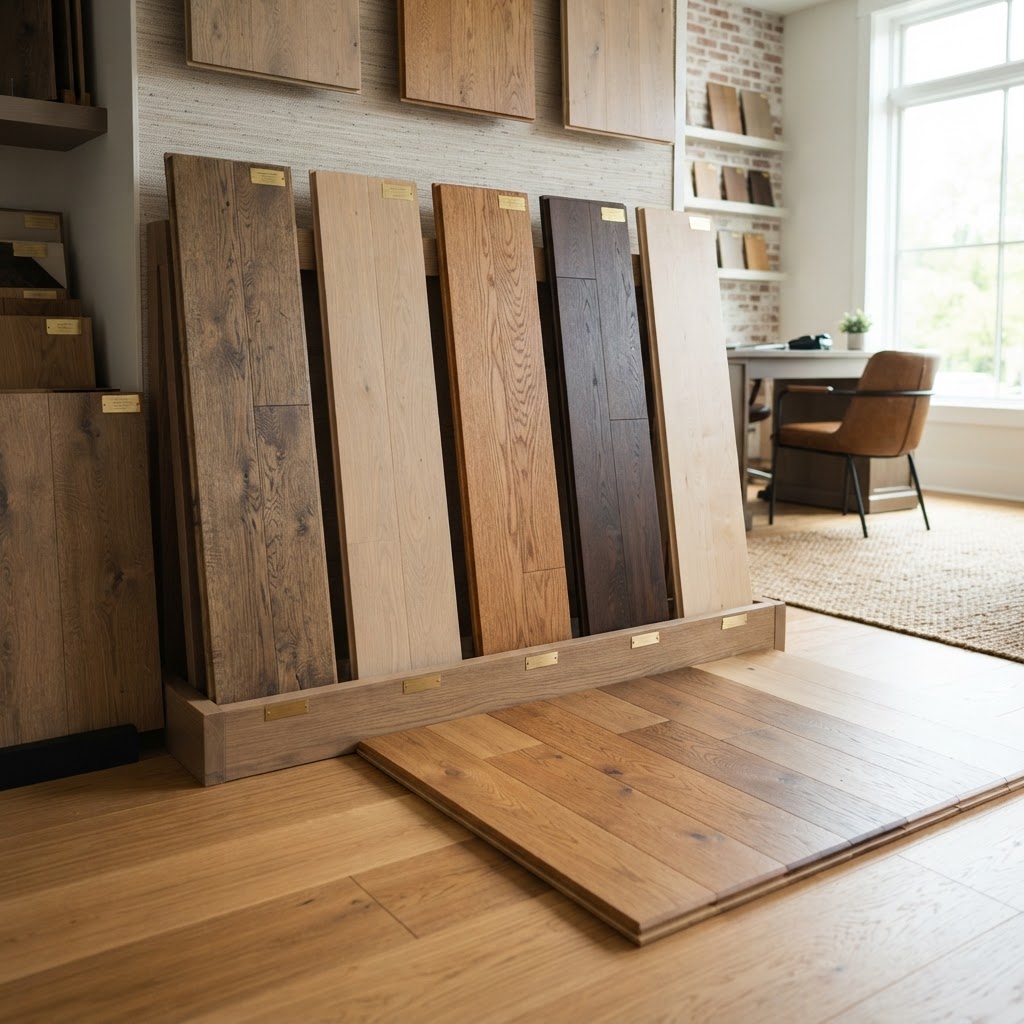
Why Maryland's Climate Makes Hardwood Flooring a Unique Challenge
Maryland sits in a climate zone that gives homeowners the worst of both worlds when it comes to hardwood flooring. Summers in Baltimore, Annapolis, and the Washington suburbs bring oppressive humidity — regularly pushing above 70% relative humidity from June through September. Then winter arrives with dry, forced-air heat that can drop indoor humidity levels below 30%. That 40-point seasonal swing is one of the most punishing conditions wood flooring can endure.
Wood is hygroscopic, meaning it constantly absorbs and releases moisture from the surrounding air. When humidity rises, wood expands. When humidity drops, wood contracts. Do that repeatedly over years, and you end up with cupping, gapping, squeaking, and cracked finish — problems I've seen firsthand in hundreds of Maryland homes over my contracting career. The good news is that choosing the right species, cut, and installation method from the start eliminates most of these headaches entirely.
Understanding Maryland's Housing Stock
Before talking species, it helps to understand where that floor is actually going. Maryland's housing stock is remarkably diverse, and the structure of the home matters as much as the wood itself.
Baltimore Rowhomes
Baltimore's classic two- and three-story brick rowhomes — particularly in neighborhoods like Hampden, Charles Village, Remington, and Canton — present specific installation challenges. Many of these homes were built between 1880 and 1940 on concrete slab foundations or with shallow crawl spaces. Ground-level moisture intrusion is common. Installing solid hardwood directly on or below grade in a Baltimore rowhome is a recipe for disaster. In these situations, engineered hardwood or a properly acclimated solid wood installed above grade with a robust vapor barrier is the responsible choice.
Suburban Colonials and Craftsman Homes
In Montgomery County, Howard County, and Anne Arundel County, you'll find a large inventory of colonial-style homes built on raised wood-frame subfloors from the 1960s through the 1990s. These homes are generally well-suited for solid hardwood installation on the main and upper levels. However, their finished basements — increasingly popular for recreation rooms and home offices — still require engineered products. A finished basement in Columbia or Gaithersburg might feel perfectly dry, but the slab beneath it will still cycle through moisture levels that will destroy a solid hardwood floor within a few seasons.
Eastern Shore and Mountain Properties
Homes near the Chesapeake Bay and on the Eastern Shore face elevated ambient humidity practically year-round. Properties in Western Maryland near Deep Creek Lake deal with dramatic temperature swings and heavy snowfall that pushes moisture into structures from outside. Both environments demand extra attention to acclimation periods and vapor management before any hardwood installation begins.
The Best Hardwood Species for Maryland Conditions
Not all wood moves equally with humidity changes. The Janka hardness rating tells you about dent resistance, but the tangential and radial shrinkage coefficients tell you how much a species actually moves with moisture — and that's the number that matters most in Maryland.
White Oak: The Maryland Workhorse
White oak is my top recommendation for most Maryland homeowners, and it's not a close contest. With a moderate shrinkage coefficient and a tight, closed grain structure, white oak handles humidity fluctuations better than almost any domestic species. It's also naturally resistant to moisture penetration, which is part of why it was the wood of choice for Chesapeake Bay shipbuilders for centuries. White oak pairs beautifully with both the historic character of an older Baltimore rowhome and the clean lines of a newer Bethesda colonial. In rift-sawn or quartersawn cuts, its dimensional stability improves even further.
Red Oak: Popular But Proceed with Caution
Red oak remains the most installed hardwood floor in America, and it's widely used in Maryland as well. It's slightly less stable than white oak and has a more open grain that absorbs moisture more readily. That said, red oak performs adequately in well-conditioned Maryland homes where a whole-home humidification and dehumidification system keeps relative humidity between 35% and 55% year-round. Without that humidity control, red oak in a Maryland home is more prone to seasonal gapping than white oak.
Hickory and Hard Maple: Beautiful but Demanding
Hickory is extremely hard and visually dramatic, but it's also one of the more dimensionally unstable domestic species. In Maryland's climate, wide-plank hickory floors require meticulous humidity management or they will gap noticeably every winter. Hard maple has similar stability challenges and shows moisture-related movement more visibly because of its light, uniform color. I recommend these species to Maryland homeowners only when a whole-home HVAC system with humidity control is already in place.
Engineered Hardwood: Not a Compromise
There's a persistent myth that engineered hardwood is a lesser product. It isn't. A high-quality engineered hardwood — one with a real hardwood veneer of 3mm or more bonded over a cross-ply plywood core — offers superior dimensional stability compared to solid wood in any climate, and it's the correct technical choice for below-grade or on-grade installations throughout Maryland. Look for products with a minimum of seven plies and avoid anything with an HDF (high-density fiberboard) core, which responds poorly to moisture exposure over time.
Width, Cut, and Finish: Details That Define Performance
Plank Width
Wider planks look stunning, but physics works against them in humid climates. A 7-inch plank will expand and contract significantly more in absolute terms than a 3-inch strip floor, even if the percentage movement is identical. For Maryland homes without a whole-home humidity control system, I generally recommend keeping solid hardwood plank width at 4 inches or under. If you're committed to wide planks — say, 5 inches or more — use a rift-sawn or quartersawn cut and plan to install engineered rather than solid.
Sawn Cut Matters
- Flatsawn (Plainsawn): Most common and least expensive, but most prone to cupping in humid conditions.
- Riftsawn: More stable, with a consistent linear grain pattern. A solid upgrade for Maryland installations.
- Quartersawn: Most dimensionally stable of the three. Excellent choice for wide planks in humid Maryland environments.
Finish Selection
The finish seals the wood's surface and slows — but does not stop — moisture exchange. Oil-modified urethane and water-based urethane finishes both perform well in Maryland when properly applied in multiple coats. Penetrating oil finishes are beautiful and easy to spot-repair, but they offer less of a moisture barrier than film-forming finishes, making them a riskier choice in high-humidity areas of the home. Hardwax oil finishes have grown in popularity and perform respectably, but they require more routine maintenance than urethane systems.
Acclimation and Installation: Where Most Problems Actually Start
Even the best hardwood floor will fail if it's installed incorrectly. In Maryland, proper acclimation is non-negotiable. Flooring should be delivered to the installation site and allowed to acclimate in the room where it will be installed — not in a garage or basement — for a minimum of five to seven days, with the home's HVAC system operating at normal living conditions. Moisture content of the wood and the subfloor should be measured with a calibrated pin or pinless moisture meter before installation begins. The acceptable moisture content differential between wood flooring and subfloor is generally 2% for strip flooring and 1% for wide-plank flooring.
"The most expensive hardwood floor I've ever seen fail wasn't cheap material installed poorly — it was premium white oak installed by an impatient crew during a Baltimore July without proper acclimation. The boards cupped within 60 days. Don't rush this step."
Humidity Control: The Investment That Protects Every Other Investment
If you're investing $8,000 to $20,000 or more in hardwood floors for a Maryland home, the single most protective measure you can take is installing a whole-home humidification system on your furnace and a standalone or integrated dehumidification system for humid months. Keeping your home's relative humidity between 35% and 55% year-round virtually eliminates seasonal movement issues. It also protects wood furniture, musical instruments, and the structural elements of the home itself. The cost of a quality whole-home humidifier and dehumidifier system is a fraction of what you've spent on the floors — and it makes every hardwood species perform dramatically better.
Questions to Ask Before You Buy
- Is this floor being installed above grade, on grade, or below grade?
- Does my home have a humidity control system in place?
- What is the current moisture content of my subfloor?
- Will the installer measure moisture levels before and after acclimation?
- What is the manufacturer's recommended humidity range for this product?
Any reputable Maryland flooring contractor should answer these questions without hesitation. If they can't — or won't — keep looking. The right installation partner understands that in Maryland, a beautiful hardwood floor is the result of good science as much as good craftsmanship.