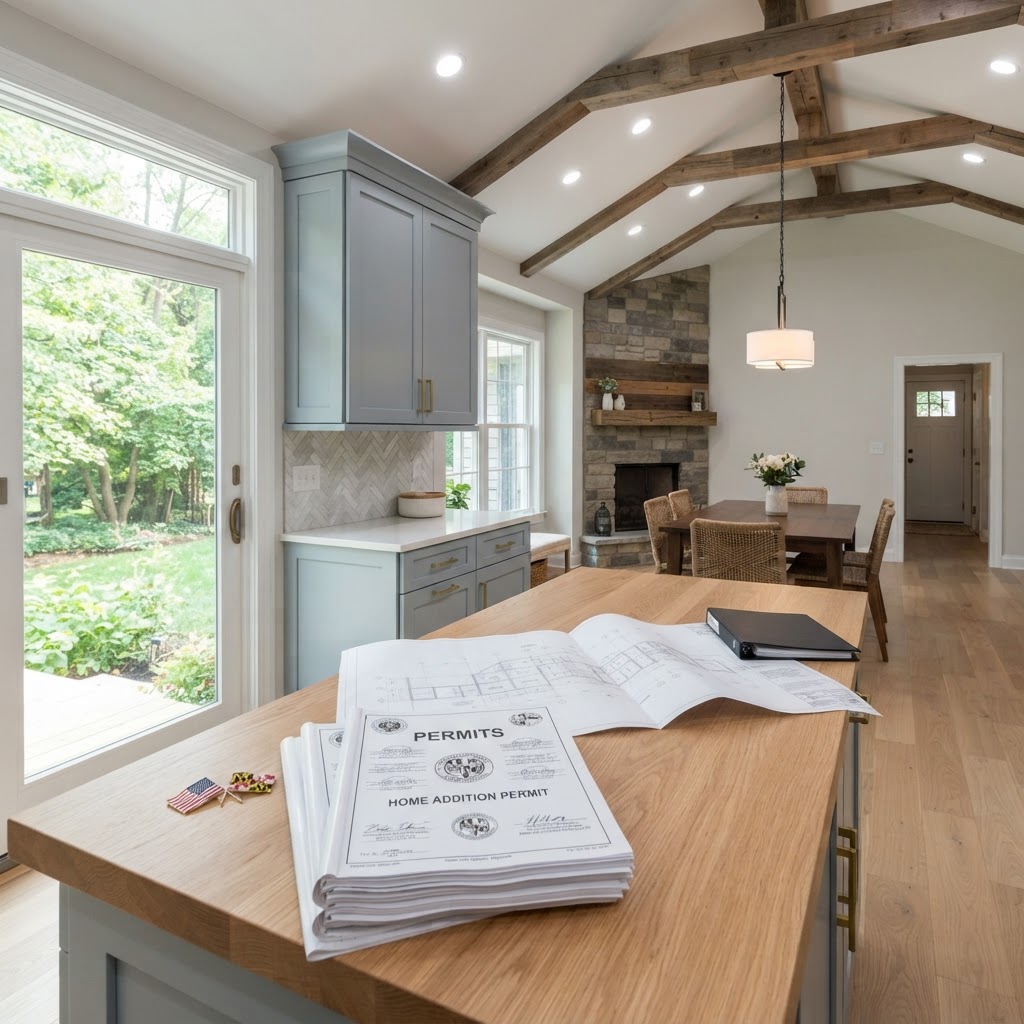
Why Permits Are Non-Negotiable for Baltimore County Home Additions
If you're planning to add a room, bump out a kitchen, or build a second-story addition to your home in Baltimore County, pulling the proper permits isn't optional — it's the law, and more importantly, it protects you. As a licensed Maryland contractor (MHIC #105430) who has worked on hundreds of additions across the county, I've seen firsthand what happens when homeowners skip this step: failed home sales, costly demolition orders, and insurance claims that get denied. Don't let that be your story.
Baltimore County's Department of Permits, Approvals and Inspections (PAI) oversees residential construction permitting. Their requirements exist for legitimate reasons — Maryland's climate alone, with its brutal summer humidity, freeze-thaw winter cycles, and occasional severe storms, makes structural and envelope integrity genuinely critical. A poorly permitted addition that skips proper insulation or drainage details can deteriorate fast in our Mid-Atlantic environment.
What Triggers a Permit Requirement in Baltimore County
Not every home improvement project needs a permit, but virtually every true "addition" does. Here's what consistently requires a building permit in Baltimore County:
- Any addition that increases the footprint or living square footage of the home
- Second-story additions or additions that alter the roofline
- Attached garages or sunrooms being converted to conditioned living space
- Structural modifications to bearing walls to accommodate the addition
- Any new electrical, plumbing, or HVAC work associated with the addition
Decks, detached structures over 144 square feet, and even some large shed installations carry their own permit requirements. When in doubt, call the PAI office at 410-887-3637 or visit their portal before breaking ground. A quick phone call saves months of headaches.
Understanding Baltimore County's Zoning Rules Before You Design
Permits and zoning are two different hurdles. Your permit application will be reviewed against your zoning classification, and Baltimore County has dozens of residential zoning designations — DR (Density Residential), R, RC, and others — each with specific rules about setbacks, lot coverage, and building height.
Here's a practical example: if you own a suburban colonial in Towson, Lutherville, or Catonsville — the kind of 1960s or 1970s center-hall colonial that dominates Baltimore County's older suburbs — your rear yard setback might require that any addition stay at least 25 feet from the rear property line. A bump-out that looks perfectly reasonable on a sketch might violate that setback and require a variance before you can even apply for a permit.
For homeowners in older, denser neighborhoods closer to Baltimore City — think the semi-detached rowhome-style properties in Dundalk, Essex, or Parkville — side yard setbacks are often tighter, sometimes as little as 5 feet. These constraints significantly shape what kind of addition is feasible without a variance process, which adds both time and cost.
The Baltimore County Permit Application Process, Step by Step
- Hire a licensed designer or architect to prepare construction drawings. Baltimore County requires detailed plans for additions, including site plans, floor plans, elevations, and structural details. Generic online plans won't pass review.
- Submit your application through eMaps, Baltimore County's online permitting portal. You'll upload your drawings, complete the application, and pay an initial fee.
- Plan review is conducted by multiple agencies — zoning, building, and sometimes fire marshal, depending on scope. Expect 4 to 10 weeks for residential addition review, though complex projects can run longer.
- Permit issuance happens once all comments are resolved. Your contractor posts the permit card on-site before work begins.
- Inspections occur at multiple stages: footing, framing, rough-in electrical/plumbing/HVAC, insulation, and final. You must pass each inspection before proceeding to the next phase.
- Certificate of Completion is issued after a successful final inspection. This is your proof that the work was done legally and to code.
What It Actually Costs to Permit a Home Addition in Baltimore County
Permit fees in Baltimore County are calculated based on the estimated construction value of the project. As a general baseline, expect to pay roughly $8 to $15 per $1,000 of construction value in combined fees, though the exact schedule is tiered and available on Baltimore County's PAI website. A $150,000 addition might carry permit fees in the range of $1,200 to $2,000, not including any separate trade permits for electrical, plumbing, or mechanical work.
Those trade permits add up. A full addition with HVAC extension, new bathroom, and electrical panel upgrade might involve three or four separate permit pulls, each with its own fee. Budget accordingly — and make sure your contractor is pulling every one of them, not just the building permit.
"A reputable contractor will always pull permits in their own name and license number. If someone offers to 'skip the permit to save you money,' walk away. That savings evaporates the moment you try to sell your home or file an insurance claim."
Maryland Climate Considerations That Affect Addition Design
Baltimore County's climate sits in IECC Climate Zone 4A — mixed-humid. This has real implications for how your addition must be built, and the county's plan reviewers know what to look for.
Insulation minimums under the current Maryland Building Code (which adopts the International Residential Code with state amendments) require R-20 or R-13+5 in exterior walls, R-49 in ceilings, and continuous insulation strategies that prevent thermal bridging. Moisture management is equally critical. Our humid summers drive vapor into wall assemblies, and our cold winters reverse that drive. An addition that isn't detailed correctly for this climate will develop mold, rot, and energy performance problems within years.
For additions to older colonials and Cape Cods that still have knob-and-tube or aluminum wiring, the addition project often triggers an electrical service evaluation. This is actually a good thing — it surfaces a latent risk. Foundation considerations matter too, especially in areas with heavier clay soils common in parts of Baltimore County, where frost depth and drainage must be carefully addressed in footing design.
Common Mistakes Baltimore County Homeowners Make
- Starting construction before permit approval. Baltimore County inspectors will issue stop-work orders and can require demolition of unpermitted work.
- Using an unlicensed contractor. In Maryland, any contractor doing work over $500 must carry an MHIC license. Verify your contractor's license at Maryland DLLR's website.
- Ignoring HOA approval. Many Baltimore County communities have HOAs with architectural review requirements separate from county permits. You need both approvals.
- Underestimating plan review timelines. Homeowners who assume a 2-week turnaround and schedule their contractor accordingly end up paying to hold crews or losing them to other projects.
- Failing to document inspections. Keep your inspection records and the certificate of completion with your home's permanent records. Future buyers and their lenders will ask for them.
Working With a Licensed Contractor Makes the Process Manageable
Navigating Baltimore County's permitting process is genuinely complex, but it becomes much more manageable when your contractor has done it many times before. An experienced local contractor knows which plan reviewers flag which issues, understands the county's current code interpretation on tricky details, and maintains relationships with the inspection department that keep projects moving.
Before hiring anyone for a home addition, ask specifically: How many permitted additions have you completed in Baltimore County in the last three years? Ask for the permit numbers — you can verify them through eMaps. This isn't about distrust; it's due diligence on one of the largest investments you'll make in your home.
Done right, a permitted home addition in Baltimore County adds genuine appraised value, keeps your homeowner's insurance intact, and gives you a finished space you can enjoy without looking over your shoulder. The permit process exists to ensure the work is safe, sound, and built to last in our demanding Mid-Atlantic climate. Respect the process, hire qualified professionals, and your addition will serve your family for decades.