What Maryland Homeowners Are Choosing for Kitchen Countertops Right Now
If you've been inside a dozen Maryland kitchens over the past year — and between job sites in Baltimore City, Anne Arundel County, and Howard County, I certainly have — you start to notice patterns. Homeowners aren't just chasing Instagram trends anymore. They're making smarter, more regionally informed decisions about countertop materials, colors, and edge profiles. Maryland's unique blend of historic architecture, humid summers, and practical Chesapeake sensibility shapes those choices in ways that a generic home improvement blog won't tell you.
Whether you're renovating a 1920s Baltimore rowhome in Hampden, updating a 1980s colonial in Columbia, or finishing a new build in Ellicott City, the countertop you choose matters — aesthetically, functionally, and financially. Let's break down what's actually trending, what holds up in our Mid-Atlantic climate, and what I recommend after decades of installing these surfaces across the state.
Why Maryland's Climate Matters for Countertop Selection
Maryland sits in a humid subtropical transition zone. Our summers are hot and muggy, our winters bring freeze-thaw cycles, and homes in areas like the Eastern Shore deal with salt air on top of everything else. That matters more than you might think when you're selecting a countertop surface.
Humidity fluctuations cause wood to expand and contract, which is why butcher block countertops require more maintenance in Maryland kitchens than they would in, say, Arizona. Porous stone like unsealed marble can absorb moisture and stain more aggressively in a high-humidity kitchen. And if your rowhome or older colonial has a kitchen that doesn't have great ventilation, you'll want a surface that can handle steam and condensation without degrading.
This isn't meant to scare you off any particular material — it's meant to help you make a decision with your eyes open. Every material on this list can work beautifully in a Maryland home when properly installed and maintained.
The Top Countertop Trends We're Seeing Across Maryland
1. Quartz: Still Dominant, But Getting More Interesting
Engineered quartz has been the workhorse of Maryland kitchen renovations for the past decade, and it's not going anywhere. What is changing is how homeowners are using it. The plain white-and-grey slabs that dominated the 2010s are giving way to more dramatic veining, warmer tones like creamy beige and terracotta-adjacent blends, and bookmatched patterns that mimic high-end natural stone.
For Maryland homeowners, quartz remains an excellent choice because it's non-porous, resists staining from crab feasts and Old Bay spills, and requires virtually no sealing. Brands like Cambria (which has strong regional distribution) and Silestone are popular at the mid-to-high end. If you're renovating a Baltimore rowhome with limited natural light, I often recommend a quartz with subtle warm veining — it brightens the space without looking sterile.
2. Quartzite: The Upgrade Move for Serious Kitchens
Quartzite — and please, do not confuse this with quartz — is a natural metamorphic stone that has been surging in popularity among Maryland homeowners who want the drama of marble without the maintenance nightmare. Visually, quartzite like Super White or Taj Mahal offers sweeping grey and gold veining that photographs beautifully and holds up far better than marble to acid etching.
The caveat: quartzite does need to be sealed, and in Maryland's humidity, that seal should be refreshed annually. It's also not cheap — installed costs in the Baltimore-Washington corridor typically run between $80 and $130 per square foot depending on the slab and fabricator. But for a forever kitchen in a Federal Hill rowhome or a Bethesda colonial, it's a serious investment that adds real resale value.
3. Porcelain Slabs: The Underrated Contender
Large-format porcelain slabs are having a genuine moment, and I think they deserve more attention than they get in Maryland. These ultra-thin, ultra-hard panels — often from Italian manufacturers like Dekton or Neolith — can replicate the look of marble, concrete, or even wood grain with remarkable accuracy. They're essentially impervious to staining, heat, and moisture.
For older Maryland homes where the substructure might not support the weight of a full natural stone slab, porcelain is worth serious consideration. It's also a strong choice for outdoor kitchen counters in Annapolis or on the Eastern Shore, where you need something that can handle freeze-thaw cycles and direct sun without cracking or fading.
4. Butcher Block: Comeback Kid With Caveats
Butcher block never fully went away, but it's seeing renewed interest, particularly in charm-forward rowhome renovations where homeowners want warmth and character. In kitchens with white or navy shaker cabinets — a look that's everywhere in Baltimore's Charles Village and Remington neighborhoods — a walnut or maple butcher block counter adds genuine soul.
My honest advice: in Maryland, treat butcher block as a conscious lifestyle choice, not a low-maintenance option. You need to oil it regularly with food-safe mineral oil, keep it dry between uses, and accept that it will develop character marks over time. Some people love that. Others don't. Know which type you are before you commit.
5. Concrete Countertops: Niche but Noteworthy
Poured or precast concrete countertops are a niche choice, but they show up regularly in high-design Maryland kitchens — particularly in modern industrial renovations of older commercial buildings turned into loft condos in areas like Station North or Canton. Concrete allows for total customization of shape, color, and texture, including integrated drainboards and trivets.
The tradeoff is that concrete is porous and will stain if not properly sealed, and hairline cracks can develop over time. For the right homeowner, it's a striking and deeply personal choice. For someone who wants set-it-and-forget-it practicality, it's probably not the right call.
Color and Edge Trends Worth Knowing
Beyond material, Maryland homeowners are making some distinct aesthetic moves right now:
- Warm neutrals over cool greys: The grey-everything era is winding down. Creamy whites, warm taupes, and soft greens are now the dominant countertop palette requests we're seeing from Rockville to Annapolis.
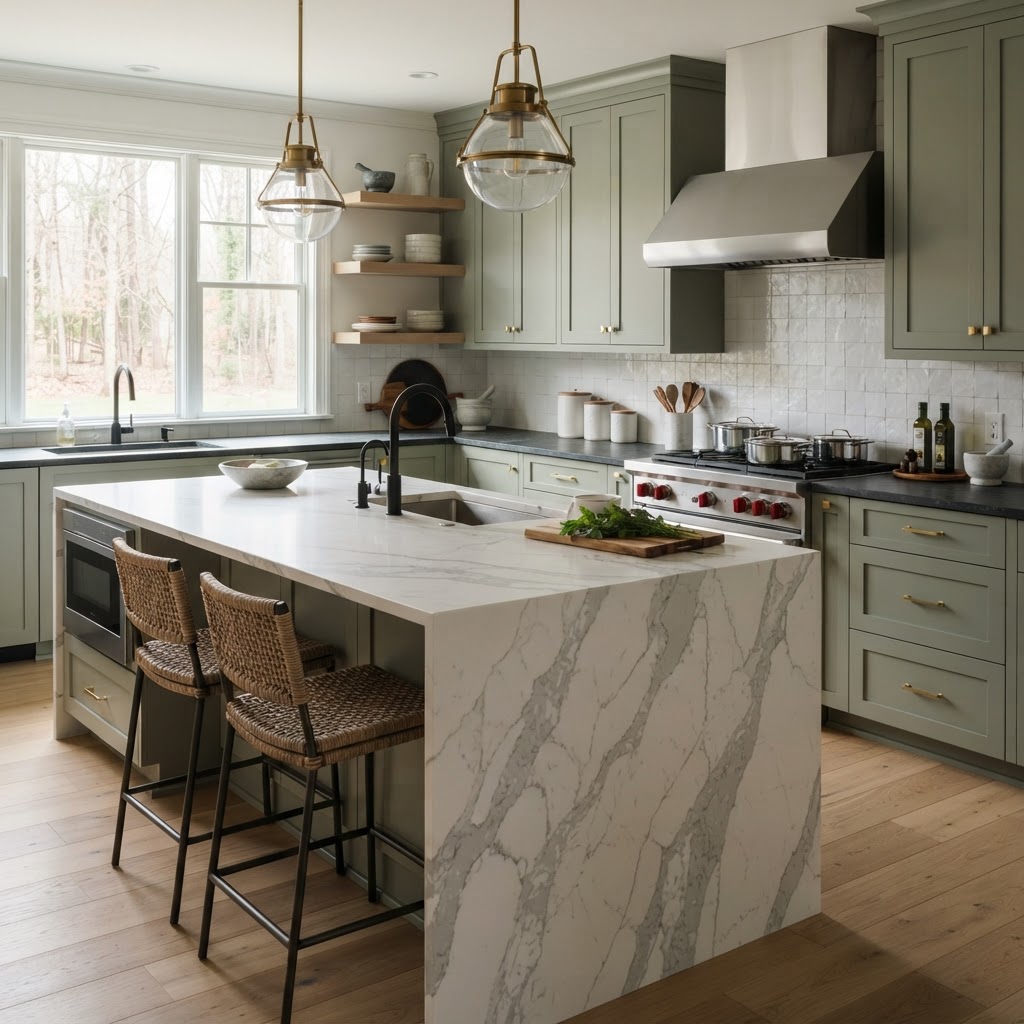
- Waterfall edges: Particularly popular in open-concept colonials where the island is a focal point. A waterfall edge — where the slab continues vertically down the cabinet side — reads as a premium, architectural detail.
- Leathered or honed finishes: Polished surfaces show every water spot and fingerprint. Honed and leathered finishes are gaining traction for their more forgiving, matte appearance, especially on darker stones.
- Mixed surfaces: Using two different countertop materials in the same kitchen — say, quartz on the perimeter and butcher block on a prep island — is becoming a smart, designer-approved approach that also helps manage budget.
Practical Advice Before You Commit
Before you sign a contract with any fabricator, here are a few things I always tell Maryland homeowners:
- Visit the slab yard in person. Small samples lie. You need to see the full slab under actual lighting conditions before you commit, especially for natural stone.
- Get at least three quotes. Fabrication and installation pricing varies significantly across Maryland. A countertop that costs $6,000 in one quote might come in at $4,200 from a different licensed fabricator without any difference in quality.
- Ask about lead times. Supply chain issues have improved since the pandemic, but custom stone fabrication in the Baltimore-Washington metro can still run four to six weeks. Plan accordingly if you have a hard move-in deadline.
- Verify your contractor is MHIC-licensed. Maryland's Home Improvement Commission (MHIC) licensing exists to protect you. Any contractor performing countertop installation as part of a broader kitchen renovation in Maryland is required to carry an active MHIC license. You can verify any license number, including mine (MHIC #105430), on the Maryland DLLR website.
The Bottom Line for Maryland Kitchens
The best countertop for your Maryland kitchen is the one that fits how you actually cook, how much maintenance you're genuinely willing to do, and how long you plan to stay in the home. Trends matter for resale, but they should inform your decision — not make it for you.
"A countertop is one of the most-touched surfaces in your home. Choose something you'll love looking at every morning for the next twenty years, not just something that photographs well for the listing."
If you're planning a kitchen renovation anywhere in Maryland and want an honest assessment of your options given your specific home, budget, and timeline, that's exactly the kind of conversation worth having before a single cabinet gets pulled. The decisions you make at the planning stage — including what goes on top of those cabinets — will shape how you feel about that kitchen for decades.