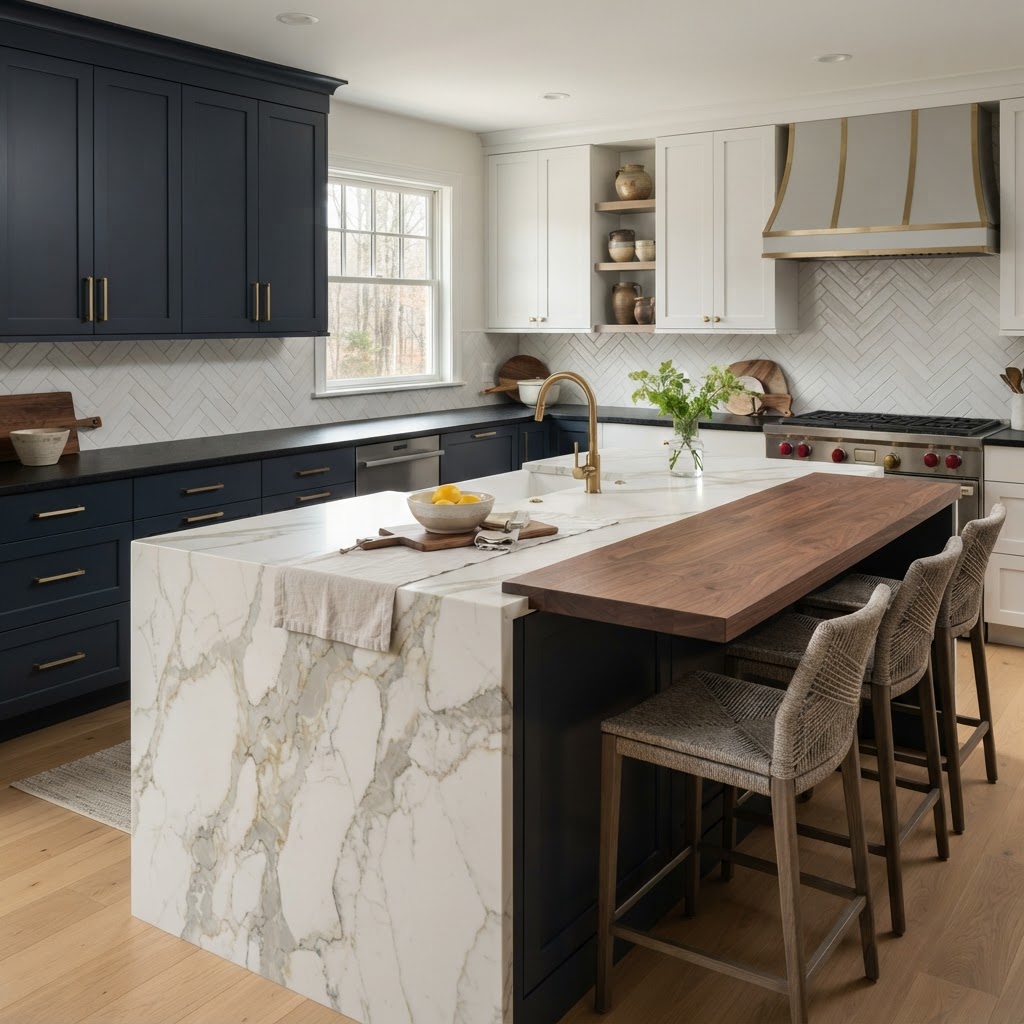
What Maryland Homeowners Are Choosing for Kitchen Countertops in 2025
Whether you own a Federal Hill rowhome, a Rockville colonial, or a waterfront property on the Eastern Shore, your kitchen countertop is one of the hardest-working surfaces in your home. After decades of working on kitchens across the state, I can tell you that Maryland homeowners are making smarter, more intentional countertop choices than ever before. The trends we're seeing in 2025 aren't just about aesthetics—they reflect a real understanding of how our climate, home styles, and daily routines demand specific performance from materials.
Why Maryland's Climate Matters for Countertop Selection
Maryland sits in a humid subtropical transition zone. Our summers are hot and muggy, our winters bring freeze-thaw cycles, and coastal and Bay-adjacent homes deal with elevated humidity and salt air year-round. These conditions aren't just an outdoor concern—they affect your kitchen environment too.
High indoor humidity, common in older Baltimore rowhomes with limited ventilation, can affect how certain countertop materials perform over time. Natural stones like marble and limestone are porous and can absorb moisture if not properly sealed and maintained. In a Chesapeake-area kitchen that sees heavy summer humidity, an unsealed marble counter can become a harbor for bacteria and staining. This is not a reason to avoid natural stone—it's a reason to work with a contractor who understands proper sealing schedules and material compatibility for your specific home.
Quartz: Still the Workhorse, Now More Refined
Engineered quartz has dominated Maryland kitchens for the past decade, and it's not going anywhere. What's changed is the aesthetic. The stark white-and-gray slabs that flooded the market in the early 2010s are giving way to warmer tones, organic veining, and finishes that convincingly mimic natural stone.
For Maryland homeowners, quartz remains a top recommendation for practical reasons:
- Non-porous surface resists moisture absorption—critical in our humid summers
- No annual sealing required, unlike granite or marble
- Consistent appearance across large kitchen islands, which are increasingly common in suburban colonial renovations
- Excellent resale value in competitive Maryland markets like Montgomery County, Howard County, and Anne Arundel County
Brands like Cambria, Silestone, and Caesarstone are producing slabs with warm greige tones, soft terracotta veining, and matte finishes that work beautifully in both modern and traditional kitchen settings. If you're updating a 1980s colonial in Ellicott City or a 1960s split-level in Catonsville, these newer quartz offerings can modernize a space without looking out of place architecturally.
Quartzite: The Natural Stone Having Its Moment
Not to be confused with quartz, quartzite is a naturally occurring metamorphic rock that offers the visual drama of marble with significantly better durability. It's harder than granite, resistant to etching from acidic foods, and holds up well under real kitchen use.
We're seeing strong demand for quartzite in higher-end Maryland renovations—particularly in Bethesda, Annapolis, and the horse country of northern Baltimore County. White quartzite with dramatic gray or gold veining pairs exceptionally well with the classic millwork and shaker cabinetry common in Maryland's older colonial and craftsman homes.
Quartzite does still require sealing, and the quality of the seal matters. I always tell homeowners: the slab is an investment, but the installation and finishing process is what protects that investment long-term.
If you're considering quartzite, ask your contractor about the specific stone's porosity—not all quartzite is equal—and establish a realistic maintenance plan before you commit.
Porcelain Slabs: The Underdog Gaining Ground
Large-format porcelain slabs are one of the most significant shifts in the countertop market over the past three years, and Maryland contractors are taking notice. These slabs—sometimes measuring 120 inches or more—are fired at extremely high temperatures, making them virtually impervious to heat, UV exposure, and staining.
For Maryland homeowners with open-plan kitchens that flow into sunlit dining areas, porcelain's UV resistance is a genuine advantage. Quartz can fade or discolor under prolonged direct sunlight; porcelain does not. We've installed porcelain countertops in several Eastern Shore homes where large windows and seasonal sun exposure made it the clear functional choice.
The aesthetic range has also expanded dramatically. Today's porcelain slabs accurately replicate Calacatta marble, book-matched wood grain, and even concrete—without the maintenance baggage of those natural materials.
The tradeoff: porcelain is unforgiving to cut and install. It requires experienced fabricators with diamond-blade equipment. If a less experienced crew chips or cracks a slab during installation, the cost consequences are significant. Hire accordingly.
Butcher Block and Wood: A Thoughtful Niche Application
Wood countertops are not disappearing, but the way Maryland homeowners are using them has evolved. Rather than covering an entire kitchen in butcher block—which in our humid climate can warp, swell, and require intensive maintenance—designers and contractors are now specifying wood as a purposeful accent surface.
A walnut butcher block section on a kitchen island, paired with quartz perimeter counters, is a look we're seeing frequently in Baltimore rowhouse renovations and farmhouse-style kitchens in Frederick County. It adds warmth and texture without committing you to maintaining wood across every surface.
Key Maryland-specific advice: always use end-grain butcher block rather than edge-grain if possible, as it handles moisture cycling better. Apply a food-safe oil finish—not polyurethane—and re-oil seasonally. Expect the wood to move slightly with humidity changes. That's not a defect; it's the nature of the material.
Concrete: Niche but Worth Knowing
Poured-in-place concrete countertops remain a niche product in Maryland, but they have a dedicated following among homeowners doing industrial-modern renovations in neighborhoods like Station North or Hampden in Baltimore. Concrete allows for fully custom shapes, integrated drainboards, and embedded decorative elements.
Be realistic about maintenance. Concrete is porous and will stain without aggressive sealing. It can crack if the substrate or support isn't properly engineered. In the right project with the right expectations, it's a remarkable surface. In the wrong hands or the wrong kitchen, it becomes a source of regret.
Color and Edge Profile Trends Specific to Maryland Markets
Across Maryland's varied housing stock, a few design directions are consistently gaining traction:
- Warm whites and cream tones replacing the cooler bright whites of the last decade
- Waterfall edges on islands, particularly in open-plan suburban kitchens
- Eased and pencil edges over ogee profiles, reflecting a cleaner contemporary sensibility
- Two-tone applications—different countertop materials or colors for perimeter versus island
- Leathered or honed finishes on granite and quartzite, which show fewer fingerprints and water spots in busy family kitchens
Practical Advice Before You Commit
Before you select a countertop material, walk through these questions with your contractor:
- How much direct sunlight does this kitchen receive, and for how many hours per day?
- What is the current ventilation situation—does this kitchen run humid?
- What is the household's realistic maintenance commitment?
- What is the architectural style of the home, and does the material support or fight that character?
- What is the resale timeline? Some materials add more appraised value than others in specific Maryland submarkets.
The countertop market offers more quality options than at any point in the past. The risk isn't in choosing the wrong material—it's in choosing the right material and having it installed or finished improperly. Verify your contractor's MHIC license, ask for references on similar countertop projects, and don't make your final material decision without seeing a full slab sample in your actual kitchen light, at multiple times of day.
Maryland kitchens deserve surfaces that perform as well as they look. With the right guidance, yours will do exactly that.