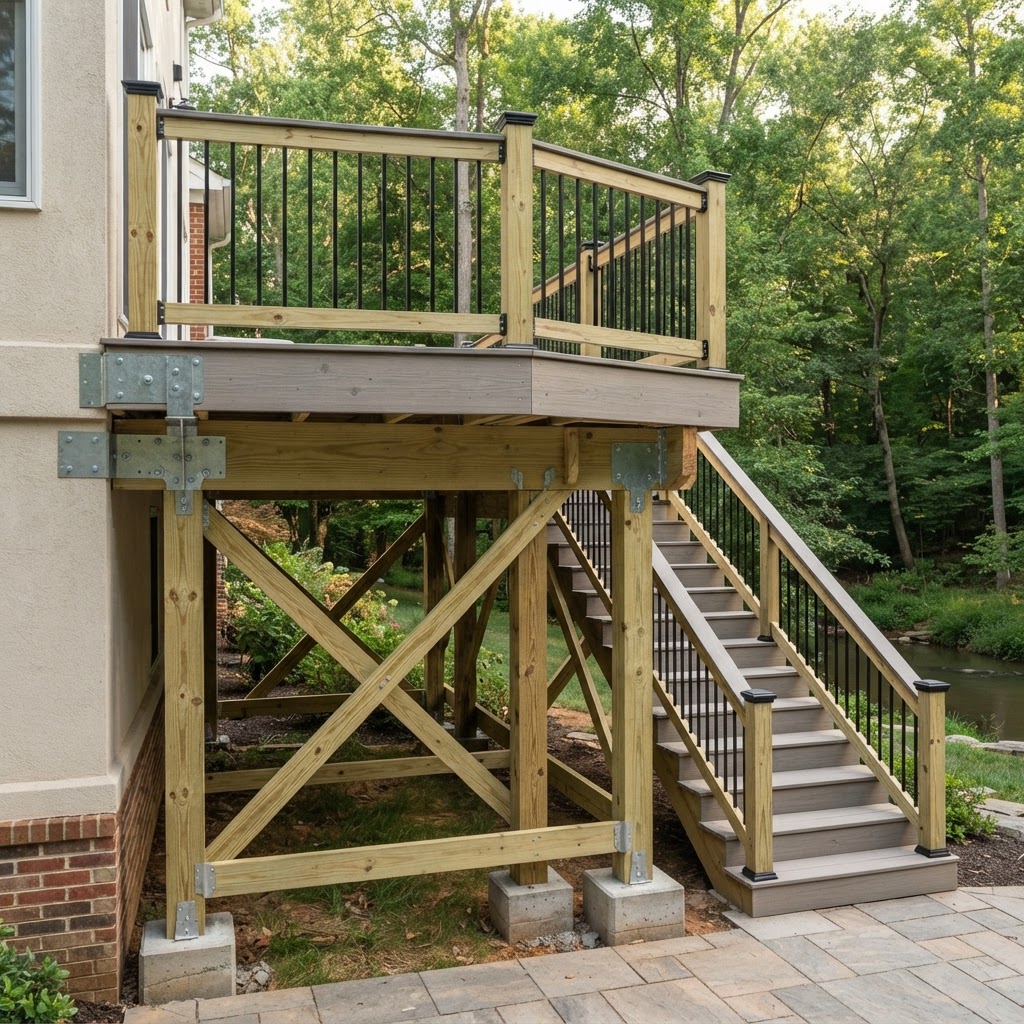
Why Maryland Deck Codes Exist — and Why You Should Care
Every year in Maryland, decks fail. Some collapse under the weight of a summer cookout. Others rot silently for years until a single misstep sends someone to the emergency room. These aren't hypothetical scenarios — they're the reason Maryland adopted the International Residential Code (IRC) with state-specific amendments, and why your county building department requires a permit before you drive a single ledger bolt.
As a licensed Maryland contractor (MHIC #105430) who has built and inspected decks from Garrett County's snowy ridgelines to the salt-air waterfront lots of Anne Arundel County, I can tell you that understanding these codes isn't just bureaucratic box-checking. It's the difference between a deck that lasts 30 years and one that becomes a liability.
Does Your Maryland Deck Require a Permit?
Short answer: almost certainly yes. Maryland follows the IRC, and most jurisdictions require a building permit for any deck that is attached to the house, more than 30 inches above grade, or larger than 200 square feet. Many counties — including Montgomery, Howard, and Baltimore County — require permits for detached structures as well once they exceed a modest size threshold.
Baltimore City rowhouse owners often ask whether a small rear deck off the kitchen needs a permit. It does. Those classic late-1800s and early-1900s brick rowhomes present a unique structural challenge: the rear wall masonry may not be rated to accept a standard ledger attachment. A permit triggers an inspection that catches exactly this kind of problem before it becomes catastrophic.
Homeowner tip: Never buy a home with an unpermitted deck without first having a licensed contractor assess it. Unpermitted structures can complicate your title insurance, homeowner's insurance claims, and resale — and they may be structurally deficient by definition.
Key Structural Requirements Under Maryland Code
Footings and Post Bases
Maryland's frost depth varies across the state. In the western mountains of Garrett County, the frost line reaches 36 inches. In Southern Maryland and the Eastern Shore, it's closer to 24 inches. Your footing must extend below the local frost depth or the freeze-thaw cycle will heave your posts out of the ground, racking the entire structure over time.
Suburban colonials in places like Columbia, Bowie, or Ellicott City typically sit on lots with compacted fill soil from 1970s–1990s development. That soil often has lower bearing capacity than undisturbed earth. Code requires footings to bear on soil with adequate capacity — in practice, that frequently means going deeper or wider than the minimum, or having a soils assessment done.
Post bases must be code-approved connectors that keep the post end-grain off the concrete, preventing moisture wicking and rot. I've seen 10-year-old decks where posts were simply set directly in concrete — a practice that was phased out of best practices decades ago and is not compliant with current Maryland-adopted IRC provisions.
Ledger Attachment
The ledger — the board that connects your deck to your house — is where the majority of deck collapses originate. Maryland code requires the ledger to be bolted or through-bolted to the house rim joist using a specific fastener pattern detailed in IRC Table R507.9.1.3(1). Lag screws must penetrate a minimum distance into solid wood framing; nails alone are never acceptable.
Flashing at the ledger is non-negotiable. Maryland's humid subtropical climate, with hot wet summers and freeze-thaw winters, accelerates wood decay wherever water can pool. Improper flashing at the ledger-to-house junction is the leading cause of long-term structural failure. Code requires continuous flashing that directs water away from the house sheathing and band joist.
Beam and Joist Sizing
Span tables in the IRC govern how large your beams and joists must be based on the load they carry and the distances they span. These aren't suggestions — they're minimums calculated to handle a 40 psf live load (people and furniture) plus a 10 psf dead load (the deck structure itself). Maryland does not increase these minimums for snow load in most residential deck applications, but if you're building in western Maryland and plan a four-season structure, that conversation with your building department is worth having.
Guardrail and Handrail Requirements
If your deck surface is 30 inches or more above grade, a guardrail is required. Maryland follows IRC R507.3 which sets the minimum guardrail height at 36 inches for decks less than 30 inches above the adjacent walking surface — but once you're above that threshold, you need 36 inches minimum, and many inspectors and jurisdictions now default to 42 inches for anything substantially elevated.
- Balusters must be spaced so a 4-inch sphere cannot pass through — this prevents small children from getting their heads trapped.
- The bottom rail opening between deck surface and the lowest rail cannot allow a 4-inch sphere to pass either.
- Guardrail systems must withstand a 200-pound concentrated lateral load at the top rail.
- Post-to-frame connections on guardrails are a chronic failure point; surface-mounted post bases that rely on short screws into decking are not code-compliant for guardrail posts.
Stairs require a graspable handrail on at least one side when there are four or more risers. Riser height must be uniform — within 3/8 inch across all risers in the run — and tread depth must be a minimum of 10 inches. On older Maryland properties where the grade is uneven or the house sits on a sloped lot, getting consistent riser heights requires careful layout work before a single stringer is cut.
Material Choices That Affect Code Compliance
Pressure-treated lumber used in Maryland deck construction must be rated for ground contact (UC4A or UC4B) where it's in contact with concrete or soil. Above-ground members can use UC3B rated material. Since 2004, the industry shifted from CCA (chromated copper arsenate) to newer preservative systems. Make sure your lumber is stamped with the appropriate use category — the stamp is your proof of compliance.
Composite decking products are widely used on Maryland homes, particularly on waterfront properties in Calvert County or the Chester River communities on the Eastern Shore where wood maintenance is a real burden. These products must be installed per the manufacturer's installation instructions, which become part of the code requirement. Composite decking that is installed without proper gapping, over an inadequate substructure, or with incorrect fasteners can void the product warranty and fail inspection.
The Inspection Process in Maryland
Most Maryland jurisdictions require at minimum two inspections: a footing inspection before concrete is poured, and a final inspection upon completion. Some counties require a framing inspection as well. Do not skip these. Footing inspections exist precisely because once concrete is poured, there's no way to verify depth without destructive testing.
Bring your approved permit drawings to the job site. Inspectors expect to see them, and deviations from the approved plans — even seemingly minor ones — can result in a failed inspection and required corrections.
Practical Advice Before You Start
- Contact your county building department early. Each Maryland county administers its own permit process. Montgomery County, Prince George's County, and Baltimore City each have distinct timelines, fee schedules, and submittal requirements.
- Hire an MHIC-licensed contractor. Maryland law requires contractors performing home improvement work over $500 to hold an active MHIC license. Verify your contractor's license at Maryland DLLR's online portal.
- Plan for your climate zone. Whether you're dealing with Chesapeake Bay humidity, western Maryland snow loads, or the urban heat island effect in Baltimore City, material selection and detailing should reflect actual local conditions, not just minimum code.
- Get your plat and utility locates. Many Maryland lots have setback requirements that affect where a deck can be placed. Call 811 before any excavation.
Building a deck in Maryland is a significant investment — typically $15,000 to $50,000 depending on size, materials, and site conditions. Doing it right, with permits and proper construction, protects that investment, keeps your family safe, and ensures your home's value is enhanced rather than encumbered. The codes aren't obstacles. They're the collective wisdom of every deck failure that came before yours.