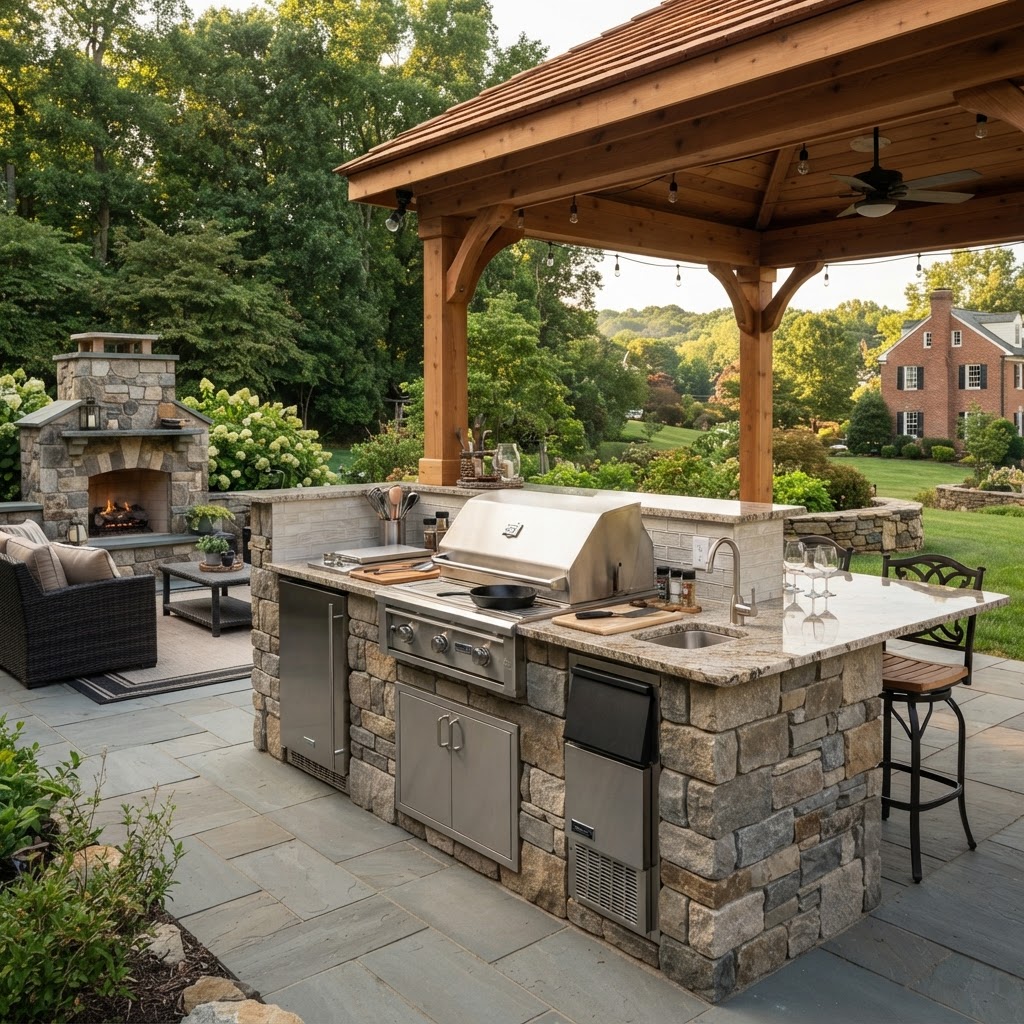
Building an Outdoor Kitchen That Works for Maryland's Climate and Lifestyle
Maryland is a state of genuine seasonal extremes. Annapolis summers push heat indexes past 100°F, Baltimore winters bring hard freezes and occasional ice storms, and the shoulder seasons deliver everything in between — including that notorious Chesapeake humidity that never fully lets go until October. If you're investing in an outdoor kitchen for your Maryland backyard, designing around those realities isn't optional. It's the difference between a space you use nine months a year and an expensive slab of granite that spends half its life under a tarp.
As a contractor who has built outdoor kitchens across Anne Arundel, Howard, Baltimore, and Montgomery counties, I've seen what works and what turns into a costly repair call two winters later. This guide gives you the honest, practical framework you need before you commit to a single material or appliance.
Understanding Maryland's Climate Demands
The mid-Atlantic climate puts outdoor structures through genuine punishment. You're dealing with a freeze-thaw cycle that can crack poorly installed masonry, summer humidity that accelerates rust and mold on the wrong materials, and UV exposure intense enough to fade lower-grade cabinetry in a single season.
Here's what that means in practical terms:
- Countertops: Granite and porcelain tile are the two most reliable choices in Maryland. Natural granite is dense enough to resist freeze-thaw cracking when properly sealed annually. Porcelain tile — particularly large-format rectified tile — handles moisture and temperature swings exceptionally well and requires less maintenance than stone. Avoid concrete countertops unless you're committed to a rigorous sealing schedule; Maryland humidity gets into hairline cracks fast.
- Cabinetry: Marine-grade polymer or stainless steel are your only serious options for base cabinets. Wood — even teak — requires more maintenance than most homeowners anticipate in our climate. I've replaced more rotted wood outdoor cabinet frames than I can count. Polymer doesn't rust, doesn't rot, and doesn't warp.
- Appliances: Specify 304-grade stainless steel at minimum. If your kitchen is within a few miles of the Bay or a tidal waterway, step up to 316-grade marine stainless. The salt air along the Western Shore and Eastern Shore is genuinely corrosive to lesser grades.
- Flooring: Textured porcelain pavers or natural bluestone are the gold standard for Maryland outdoor kitchen floors. Both handle freeze-thaw cycles well when installed over a properly compacted base with appropriate joint spacing. Avoid smooth travertine — it becomes dangerously slick when wet and pits in freeze-thaw conditions.
Designing for Your Maryland Home's Architecture
One of the most common mistakes I see is an outdoor kitchen that looks like it was dropped into the yard from a catalog — no relationship to the house behind it. Maryland's residential architecture is genuinely varied, and your outdoor kitchen should respond to it.
Baltimore Rowhomes and Smaller Urban Lots
If you're working with a Baltimore City rowhome or an older urban property in places like Hampden, Fells Point, or Silver Spring, your backyard footprint is likely tight — sometimes as small as 12 by 20 feet. The good news is that a highly functional outdoor kitchen doesn't require a large footprint. A linear or L-shaped layout along one or two walls can incorporate a built-in grill, side burner, compact refrigerator, and prep space in under 10 linear feet. In these settings, I typically recommend integrating the kitchen into an existing fence line or building a short knee wall that doubles as a privacy screen. Cedar fencing with a metal post system painted to match the home's trim keeps the aesthetic cohesive with the rowhouse character of the neighborhood.
Suburban Colonials in Howard and Montgomery Counties
The classic two-story colonial — whether in Columbia, Ellicott City, Gaithersburg, or Rockville — usually has a more generous backyard and an existing deck or patio to work with. Here the challenge is often integration: homeowners want the outdoor kitchen to feel like a natural extension of the home, not a separate structure. Using materials that echo the home's exterior — brick if the house is brick, ledger stone if the exterior has stone accents — creates visual continuity. Island layouts with a dedicated bar seating overhang work especially well for the suburban colonial footprint, where entertaining larger groups is a realistic use case.
Eastern Shore Properties
Waterfront and near-waterfront properties on the Eastern Shore present unique design opportunities and material challenges. Wind, humidity, and salt air demand the most corrosion-resistant material selections. Architecturally, these homes often have a more relaxed, coastal vernacular, and outdoor kitchens here can lean into that aesthetic with weathered ipe or composite decking, oyster shell or river rock accent walls, and built-in coolers sized for serious crab feast entertaining.
Layout and Workflow: The Fundamentals That Don't Change
Regardless of your lot size or home style, a well-designed outdoor kitchen follows the same workflow logic as an indoor one. The classic kitchen triangle — refrigeration, prep, and cooking in a functional triangle — applies outdoors. What changes is how you account for the grill's heat, smoke, and grease.
- Grill placement: Position the primary grill so prevailing wind carries smoke away from the seating area and away from the house. In most of central Maryland, prevailing summer winds come from the southwest, so placing the grill on the southwest corner of the kitchen island is a reasonable starting point. Your site will vary — pay attention to your specific yard's airflow before you set the layout in concrete.
- The utility sink: Don't skip it. A single-basin utility sink with hot and cold water transforms how you use the space. It eliminates the back-and-forth to the indoor kitchen and makes cleanup genuinely practical. In Maryland, you'll need to winterize the supply lines each fall — use a dedicated shutoff valve inside the house and install a frost-free outdoor faucet connection.
- Covered versus uncovered: I strongly recommend covering at least the primary cooking zone. A pergola with a waterproof shade sail gives you shade without full enclosure. A full roof structure — whether a shed roof extension off the house or a freestanding pavilion — extends your usable season significantly and protects your appliance investment. Any covered structure attached to the house requires a building permit in Maryland; a freestanding structure may also require one depending on square footage and your jurisdiction. Pull the permits. It protects your home's resale value and keeps your homeowner's insurance valid.
Gas Versus Charcoal Versus Electric: A Maryland Perspective
Most outdoor kitchens in this market are built around a built-in natural gas or propane grill. Natural gas is the cleanest long-term option if you have an existing gas line — running a new line to the backyard is a straightforward job for a licensed Maryland plumber and eliminates the inconvenience of propane tank management. Propane is a practical alternative for properties without natural gas service, which includes many rural areas of Frederick, Carroll, and Garrett counties.
Kamado-style ceramic grills — Big Green Egg, Kamado Joe — have a passionate following in Maryland, and built-in kamado tables have become increasingly common in higher-end outdoor kitchen builds. They require a non-combustible surround and additional clearance, but the cooking versatility is hard to argue with.
A note on permits and HOAs: Before you break ground, check with your county's permitting office and your HOA if applicable. Montgomery, Howard, and Anne Arundel counties each have specific requirements for outdoor structures, gas line extensions, and electrical work. A contractor who tells you permits aren't necessary for a full outdoor kitchen build is a contractor worth walking away from.
Budgeting Realistically for a Maryland Outdoor Kitchen
In the current Maryland market, a well-built outdoor kitchen starts at approximately $15,000 for a basic linear layout with quality appliances and a masonry or polymer base. A mid-range L-shaped kitchen with a covered pergola, built-in refrigerator, sink, and premium grill typically runs $30,000 to $50,000 installed. Full outdoor living pavilions with premium appliances, outdoor-rated cabinetry, and custom masonry can exceed $80,000 on the higher end of the market.
The return on investment is real. A well-designed outdoor kitchen in a desirable Maryland suburb typically returns 50 to 80 percent of its cost at resale, according to consistent data from Remodeling Magazine's Cost vs. Value report. More importantly, it returns value in how you use your home every single week from April through November.
Finding the Right Contractor
Maryland requires all contractors performing home improvement work valued at $500 or more to be licensed through the Maryland Home Improvement Commission (MHIC). Before you sign a contract, verify your contractor's MHIC license number at the Maryland DLLR license lookup. Ask for proof of general liability insurance and workers' compensation coverage. Request references from completed outdoor kitchen projects specifically — not just general remodeling work — and go see those projects in person if possible.
A contractor who has built outdoor kitchens in Maryland understands the permit process, the material demands of our climate, and the practical details that make a project last. That local knowledge is worth more than any catalog price list.