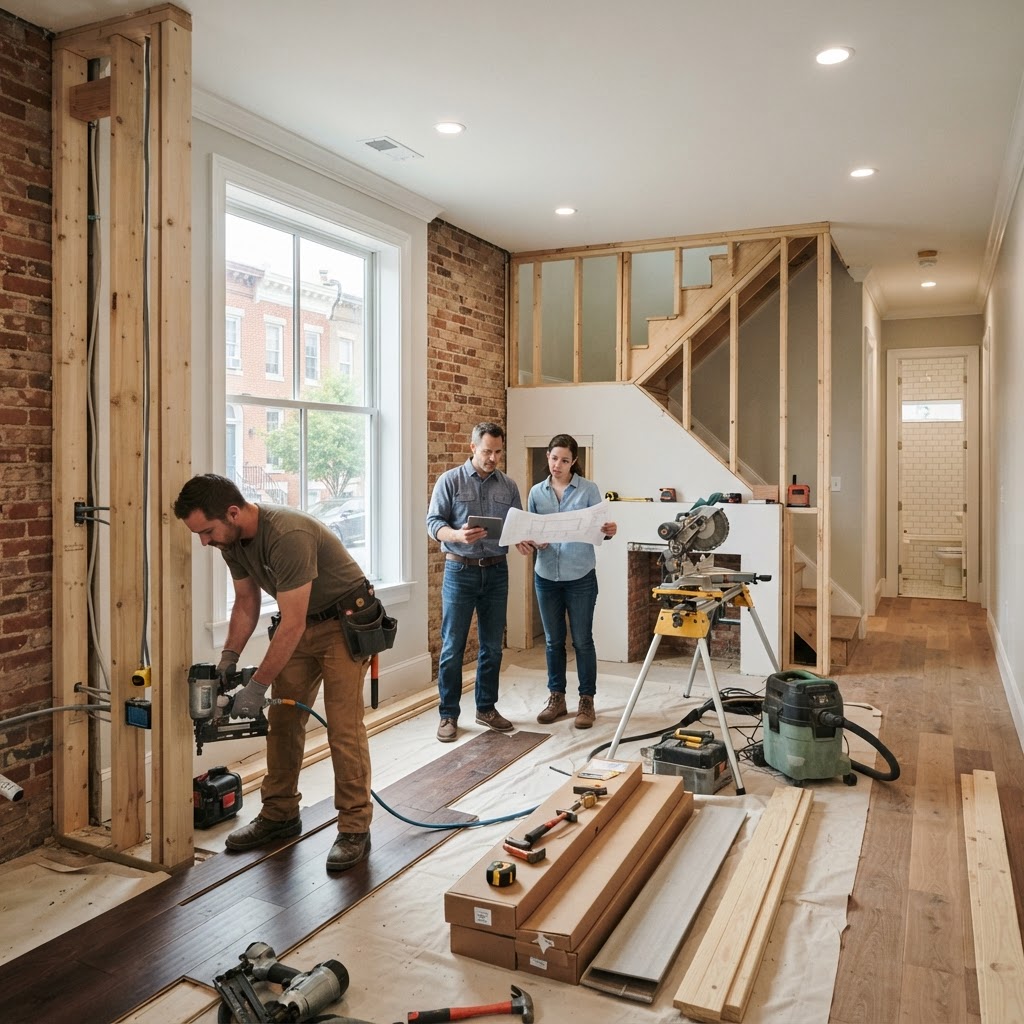
How Long Does a Whole-Home Renovation Really Take in Baltimore?
If you've been Googling renovation timelines and getting answers like "three to six months," you're not getting the full picture — especially if you own a Baltimore rowhome, a Towson colonial, or an older property anywhere in the Mid-Atlantic region. As a licensed Maryland general contractor (MHIC #105430) who has managed renovations across Baltimore City, Baltimore County, and the surrounding communities, I can tell you that a realistic whole-home renovation timeline depends heavily on your specific property type, the scope of work, permit schedules, and yes — the Maryland weather.
This guide breaks down the process phase by phase so you can plan intelligently, set accurate expectations with your family, and avoid the budget-busting surprises that derail too many renovations in this region.
Phase 1: Pre-Construction Planning (4–10 Weeks)
Before a single wall comes down, the planning phase is where your project succeeds or fails. In Baltimore, this stage often takes longer than homeowners expect for a few key reasons.
Design and Scope Development
Whether you're renovating a Federal Hill rowhome or a Catonsville split-level, the design process requires measuring existing conditions, identifying structural constraints, and making material selections. For older Baltimore City properties — many of which were built between 1880 and 1940 — this phase frequently uncovers surprises like knob-and-tube wiring, lead paint, or non-standard wall thicknesses that affect design decisions. Budget two to four weeks for design alone if you're working with an architect or designer.
Permitting in Baltimore City and County
Permit timelines in Maryland vary significantly by jurisdiction. Baltimore City DHCD can take four to eight weeks for a comprehensive residential permit, while Baltimore County typically moves faster at two to four weeks. If your project touches structural elements, electrical panels, plumbing systems, or HVAC, you will need permits — and skipping them is never worth the risk of a failed resale inspection or an insurance claim denial.
Pro tip: Submit your permit application as early as possible, even before finalizing all your finish selections. The structural and mechanical drawings are what the reviewer needs — your tile choice can come later.
Phase 2: Demolition and Rough Work (3–6 Weeks)
Once permits are in hand, the visible work begins. Demolition on a whole-home renovation is faster than most people expect — a skilled crew can gut a 1,500-square-foot rowhome in two to three days. What takes time is what comes next.
Structural Repairs and Framing
Baltimore's older housing stock is beautiful, but it carries decades of deferred maintenance, DIY modifications, and moisture damage. During rough-in, it's extremely common to discover deteriorated floor joists, improper load-bearing wall removals done by previous owners, or sagging roof sheathing — particularly in homes that experienced ice dam damage during our harsh Maryland winters. Budget time and contingency funds for structural corrections. A typical whole-home renovation in a pre-1950s Baltimore rowhome should carry a 15–20% contingency for exactly these discoveries.
Mechanical Rough-In: Plumbing, Electrical, and HVAC
Rough mechanical work runs concurrently with framing and typically takes three to five weeks depending on scope. In Baltimore rowhomes with no basement (or a very shallow one), running new plumbing and ductwork requires creative problem-solving. Many of these homes were never designed for central air conditioning, so adding a modern HVAC system — or a high-efficiency ductless mini-split system — requires careful coordination between your HVAC contractor and your framing crew.
Phase 3: Inspections and Insulation (1–2 Weeks)
After rough mechanical work is complete, your contractor schedules rough inspections with the jurisdiction's building department. In Baltimore City, getting an inspector scheduled can add three to seven business days to your timeline. This is not a phase you can rush or skip. Use this window wisely: order your cabinets and windows if you haven't already, since those are often the longest lead-time items on any renovation.
Insulation is also installed during this phase. Given Maryland's mixed climate — hot, humid summers and cold winters with frequent freeze-thaw cycles — proper insulation is critical. Spray foam insulation in the rim joist area and exterior walls of older Baltimore homes dramatically improves energy efficiency and reduces the moisture infiltration that causes so many long-term problems in this region.
Phase 4: Drywall, Finishes, and Fixtures (6–10 Weeks)
This is the phase where your home starts looking like a home again, and it's also where many renovations slow down unnecessarily due to poor scheduling and material delays.
Drywall and Paint
Hanging, taping, and finishing drywall takes one to two weeks for a typical whole-home renovation. Paint adds another one to two weeks. Do not rush the drywall finishing process — in Baltimore's humid summers, joint compound can take longer to dry, and cutting corners here leads to visible cracks and nail pops within the first year.
Cabinetry, Tile, and Flooring
Semi-custom cabinetry ordered from a Maryland supplier typically carries a six to ten week lead time. Custom cabinets can run twelve to sixteen weeks. If you're installing hardwood flooring — a popular choice in the historic neighborhoods of Roland Park, Hampden, or Guilford — allow for acclimation time. Wood flooring needs to sit in the conditioned space for a minimum of three to five days before installation, particularly important in Baltimore where humidity swings significantly between seasons.
Trim, Doors, and Hardware
Interior trim installation, door hanging, and hardware installation is finish carpentry work that deserves a skilled hand. In historic Baltimore rowhouses, matching original millwork profiles — whether it's a Victorian ogee baseboard or a craftsman-style door casing — requires sourcing from specialty millwork suppliers or custom milling. Budget time for this; it makes an enormous difference in the final appearance of your renovation.
Phase 5: Final Mechanical, Inspections, and Punch List (2–4 Weeks)
Once finishes are substantially complete, your electrician trims out fixtures and panels, your plumber installs fixtures and makes final connections, and your HVAC technician completes equipment installation and commissioning. Final inspections are then scheduled with the building department.
The punch list phase — correcting minor deficiencies before final payment — typically takes one to two weeks. A thorough contractor will walk the project with you room by room, documenting every item that needs attention. Don't skip this step or feel pressured to skip it.
Realistic Total Timeline: What to Expect
- Small whole-home renovation (under 1,500 sq ft, cosmetic focus): 4–6 months
- Mid-size renovation with structural and mechanical work: 6–9 months
- Comprehensive gut renovation of a Baltimore rowhome or colonial: 9–14 months
- Historic properties requiring preservation approvals: Add 2–4 months for review processes
Baltimore-Specific Factors That Affect Your Timeline
- Lead paint and asbestos remediation: Homes built before 1978 require lead paint testing and proper remediation protocols under Maryland law. This adds time and cost but is non-negotiable.
- Historic district approvals: Properties in Baltimore City historic districts — including parts of Fells Point, Federal Hill, and Mount Vernon — require CHAP (Commission for Historical and Architectural Preservation) review for exterior changes.
- Weather delays: Maryland winters routinely include periods of frozen ground, ice, and heavy precipitation between December and March. Exterior work — roofing, siding, foundation waterproofing — should be planned around this window.
- Material lead times: Post-pandemic supply chains have improved, but windows, custom cabinets, and specialty tile still carry significant lead times. Order early and order right.
Final Advice From a Maryland Contractor
The homeowners who have the best renovation experiences are the ones who plan conservatively, hire licensed and insured contractors (always verify your contractor's MHIC license at Maryland DLLR's online portal), and treat their contingency budget as a planning tool rather than a slush fund. A whole-home renovation is one of the largest investments you'll make — understanding the realistic timeline upfront protects that investment from the start.
If you're planning a renovation in Baltimore City, Baltimore County, or the surrounding Maryland communities, the time you invest in careful pre-construction planning will pay dividends throughout every phase that follows.